Modern Portfolio Optimization [/ˈmɑdərn pɔrtˈfoʊliˌoʊ ɑptɪmɪˈzeɪʃən/] n - Mean-variance optimization is beautiful on the blackboard and fragile in production. Markowitz showed how to find the portfolio that maximizes expected return for a given level of variance. The canonical problem is:
subject to constraints such as and position limits. The catch is that the inputs, expected returns and covariance , are estimated with error, and the optimizer treats them as known.
Hence the error-maximization property of optimizers. Small changes in expected return estimates beget large changes in portfolio weights. The optimizer heaps itself into whatever looked good in the sample, and out of sample it is oft worse than a simple equal-weighted portfolio.
Several responses present themselves. The first is constraints: limit position sizes, enforce turnover limits, require diversification, forbid extreme leverage. Constraints narrow the feasible space and make the portfolio behave. They are no confession of weak theory; they are an acknowledgment of estimation risk.
The second is shrinkage. Ledoit and Wolf showed that shrinking the covariance matrix toward a structured target betters the out-of-sample result. A target may be a constant correlation matrix, a one-factor model, or a factor covariance estimate from Linear Factor Models in Trading. In symbols:
Shrinkage is Bayesian in spirit: mingle the sample estimate with a reasonable prior.
The efficient frontier in theory is a smooth curve. In practice, estimation error blurs it into a fuzzy region:
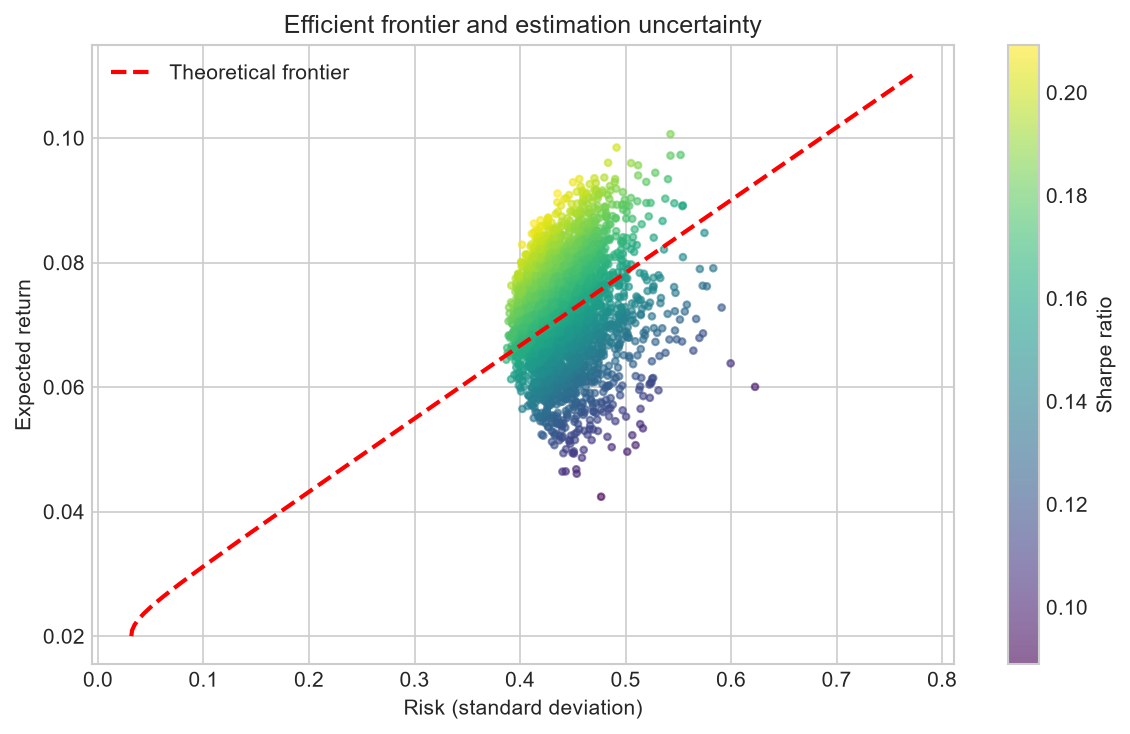 Efficient frontier with estimation uncertainty
The third is robust optimization, which reckons parameter uncertainty outright. Rather than optimizing at the point estimate, one optimizes against a worst case within a confidence set. The portfolios that result are more conservative and oft more stable.
Multi-period optimization adds dynamic rebalancing and transaction costs. The one-period model ignores the path; in truth, trading is expensive, taxes matter, and risk budgets evolve. A multi-period formulation captures something of this, at the price of complexity and computational burden.
Risk parity and maximum diversification are alternatives that want no expected return forecasts. See Risk Parity and Equal Risk Contribution for the mechanics. Maximum diversification maximizes the ratio of weighted average volatility to portfolio volatility. These approaches are loved because they sidestep the hardest input of all: expected returns.
Covariance estimation is the other half of the matter. Principal Components and Eigenportfolios reduces dimensionality, while Random Matrix Theory helps decide how many components are signal rather than noise. Copulas and Tail Dependence offers a way to model joint tail risk that covariance matrices miss.
The practical lesson is that portfolio construction concerns the governing of what one does not know. A sophisticated optimizer fed bad inputs is a swift road to ruin. A simple optimizer with sensible constraints and clean data is usually the better instrument. The optimizer is a tool; the portfolio manager is the risk control.