Random Matrix Theory [/ˈrændəm ˈmeɪtrɪks ˈθɪri/] n - Random matrix theory tells what the eigenvalues of a covariance matrix should look like when the data is mere noise. If your sample eigenvalues answer to that prediction, you are fitting noise. If a few stand out above the bulk, they may carry tidings.
For an matrix of independent, identically distributed returns with variance , the Marchenko-Pastur law gives the limiting distribution of the eigenvalues. Most such as spring from noise fall within a predictable bulk:
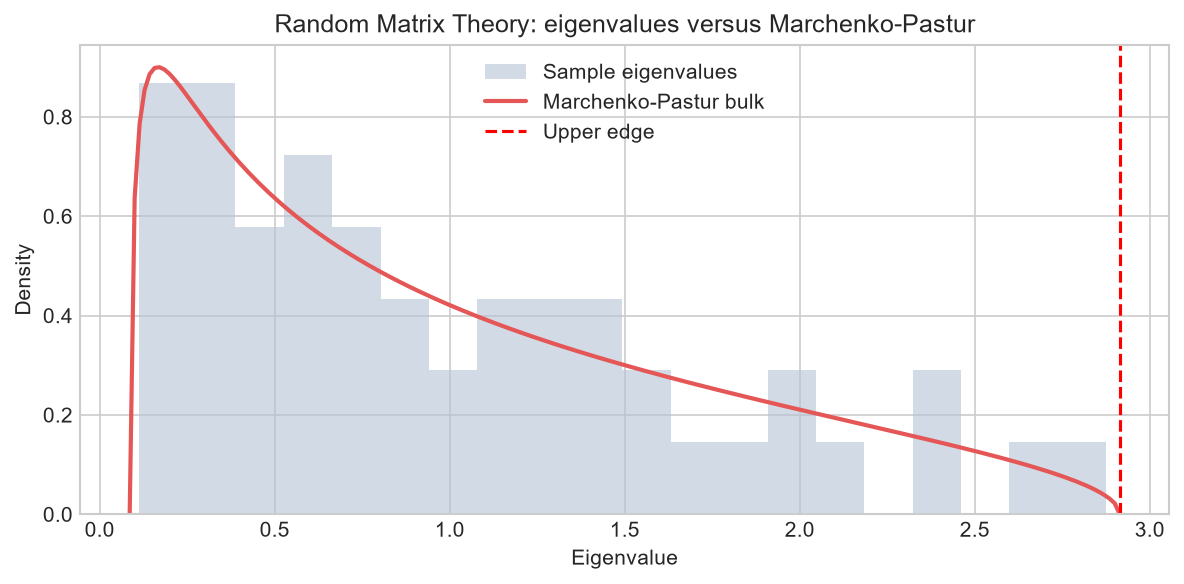 Random matrix eigenvalues versus Marchenko-Pastur
The support of that bulk is:
When is large against , the upper edge can reach surprisingly high. A covariance matrix reckoned from fifty assets and a hundred days will show eigenvalues that look meaningful, though no true structure underlies them.
In practice one cleans the matrix by setting the eigenvalues within the Marchenko-Pastur band to their average, or by shrinking them toward a target. What results is a stabler estimate for Modern Portfolio Optimization and Principal Components and Eigenportfolios.
The theory serves best when and are comparable. Ten thousand observations of ten assets, and noise is not your master; two hundred of a hundred, and it is. The ratio is the thing to watch.
It assumes independent, identically distributed returns of finite variance. Real returns are none of these, and their tails run fatter than the assumptions allow; the threshold is a heuristic, not a theorem to invoke blind. It stands as one more reason to mistrust a covariance matrix built upon too little data.