Principal Components and Eigenportfolios [/ˈprɪnsəpəl kəmˈpoʊnənts ənd ˈeigenportfolios/] n - Principal component analysis turns a correlated set of variables into uncorrelated combinations, ordered by the variance each explains. In a stock covariance matrix, the first principal component is usually the market factor. The second may be a sector or style rotation. The later components are mostly noise.
Mathematically, PCA solves:
is the covariance matrix, the matrix of eigenvectors, the diagonal matrix of eigenvalues. Each eigenvector defines a portfolio, long some names and short others, and the corresponding eigenvalue is that portfolio’s variance.
The first eigenportfolio is the direction in which the cross-section varies most. In a broad equity universe it is long everything, with weights proportional to the eigenvector loadings, and its return resembles the market return. The second is long some sectors and short others. By the tenth or twentieth component, the weights look random.
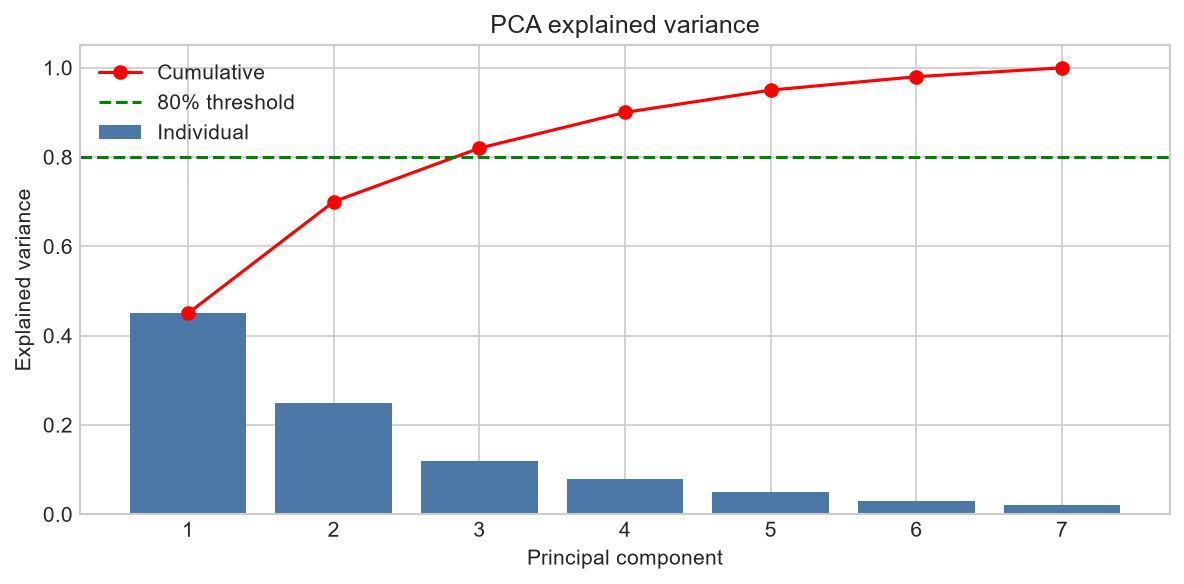 PCA explained variance
A scree plot shows how swiftly the eigenvalues decay: the first few components ordinarily explain most of the variance, and the rest are oft but noise.
PCA serves three tasks. First, dimensionality reduction: rather than modeling every stock, model a few factors and project back. Second, risk decomposition: portfolio variance may be apportioned among the principal components. Third, the unmasking of structured signals; a strategy whose returns load heavily on the first eigenportfolio is mostly beta, not alpha.
The danger is overinterpretation. Eigenvectors are estimated from sample covariance, and sample covariance is noisy. Components five through twenty may appear meaningful yet be mostly estimation error. A common rule keeps only those components whose eigenvalues exceed the average, or else applies a formal test drawn from Random Matrix Theory.
PCA assumes linear relationships and a stable covariance matrix. When correlations change, the eigenvectors change with them, and a portfolio built on last year’s principal components may behave otherwise this year. See Regime Switching and Hidden Markov Models for one way of enduring that instability.