Risk Parity and Equal Risk Contribution [/ˈrɪsk ˈpɛrəti ənd ˈikwəl ˈrɪsk ˌkɑntrəˈbjuʃən/] n - Risk parity is the notion that a portfolio should allocate capital so that each asset or risk factor contributes equally to total portfolio risk. It answers the observation that a traditional 60/40 equity-bond portfolio draws most of its risk from equities alone.
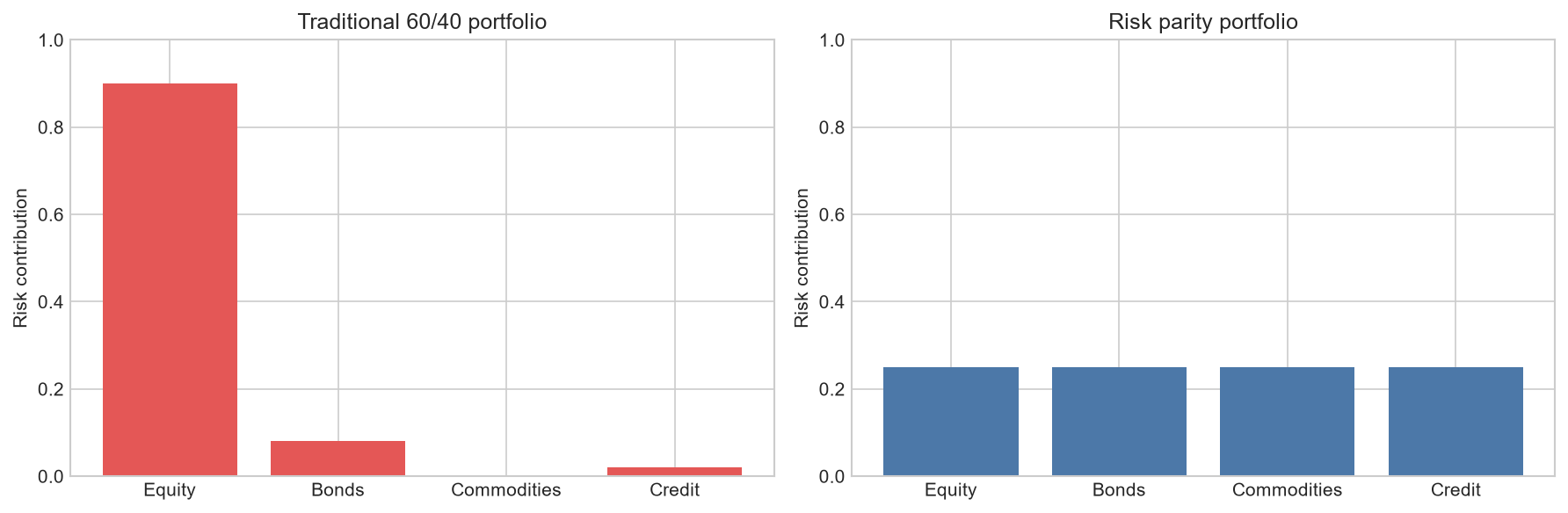 Risk contributions: 60/40 versus risk parity
Risk contribution is the marginal contribution of an asset to portfolio volatility, scaled by its weight:
where is the weight of asset and is the covariance matrix. Equal risk contribution demands for all .
The mathematics is a constrained optimization: find the weights that equalize risk contributions subject to a budget constraint. Unlike mean-variance optimization, risk parity asks for no expected return forecasts; it needs only the covariance matrix, though that matrix is still estimated with error.
Such portfolios oft employ leverage upon the low-volatility assets, raising their risk contributions to the level of the high-volatility ones. A portfolio of bonds and commodities may be levered until each bears the same measure of risk as equities. That leverage carries dangers of its own, above all during liquidity crises.
The approach generalizes to factor risk parity: equalize contributions not across assets but across factor exposures. A portfolio balanced among growth, inflation, interest rates, and credit is less likely to be ruled by a single macro regime.
Risk parity is popular because it sidesteps the hardest part of mean-variance optimization, the forecasting of expected returns. Yet it does not sidestep covariance estimation. See Modern Portfolio Optimization and Principal Components and Eigenportfolios for the kindred difficulties. A risk parity portfolio built upon a noisy covariance matrix will still be surprised.