Copulas and Tail Dependence [/ˈkopulas ənd ˈteɪl dɪˈpɛndəns/] n - A copula is a function that weds marginal distributions into a joint distribution. Differing copulas beget differing behavior in the joint tails, even when marginals and correlation are held the same:
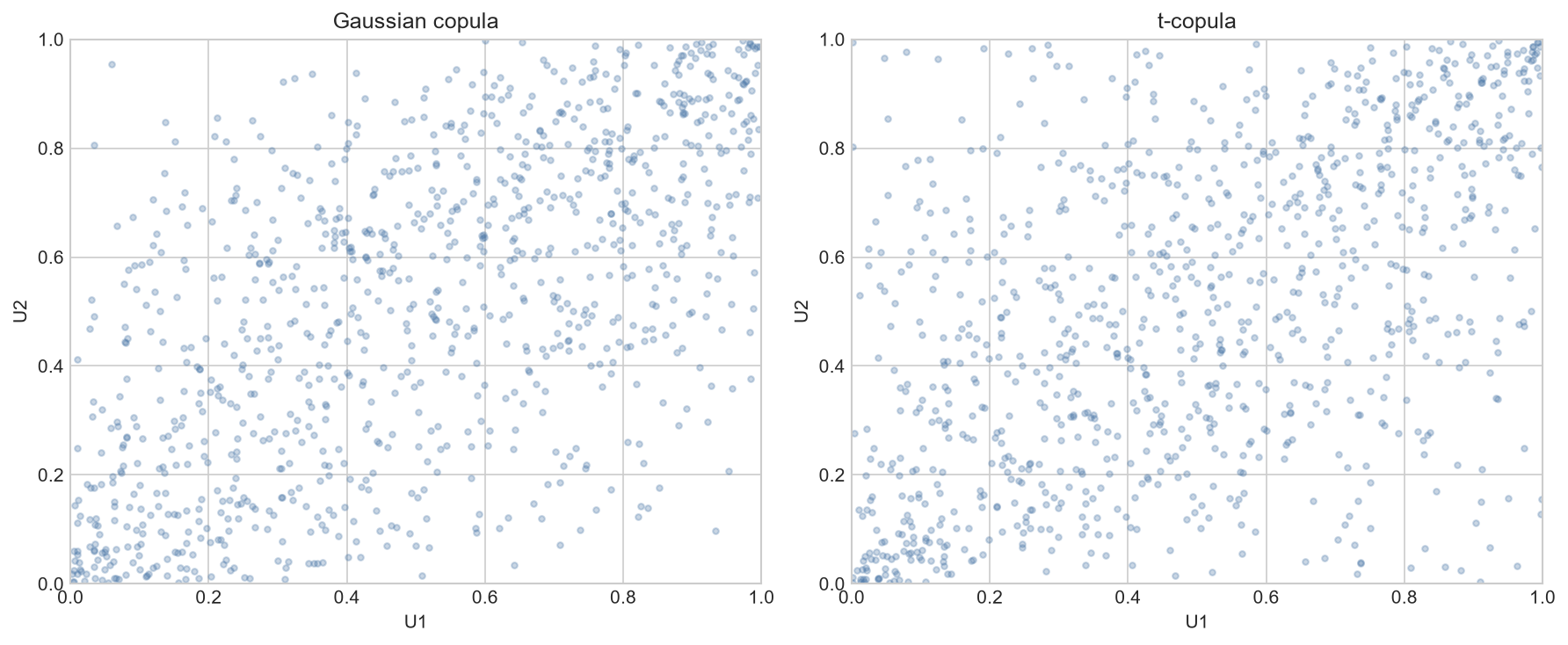 Gaussian and t copula scatter plots
Sklar’s theorem holds that any multivariate distribution may be written as a copula applied to its marginal cumulative distribution functions:
The virtue of a copula is that it sunders the modeling of each asset from the modeling of how they move in concert. One may fit heavy-tailed marginals to every asset, then choose a copula that seizes their joint conduct in the tails.
Tail dependence measures the probability that one asset suffers an extreme return given that another has suffered one. For the lower tail:
A Gaussian copula bears zero tail dependence asymptotically; a t-copula bears a positive one. In crises, assets incline to fall together, so a t-copula or an Archimedean copula may limn the joint distribution more truly than a Gaussian.
Copulas fell from favor after the 2008 crisis, having been misused to price intricate structured products. The fault was not in the mathematics but in the supposition that a copula fit to calm markets would hold through a panic. Correlations and copula parameters are not stable things.
For the management of risk, copulas serve in stress testing; see Stress Testing and Scenario Design and Value at Risk and Expected Shortfall. A copula permits the question: what befalls if several assets strike their tails at once? The answer hangs upon whether the copula structure itself will survive the stress.
To estimate a copula is harder than to estimate a correlation: one must choose a family, estimate its parameters, and prove it out of sample. The added labor is warranted only where tail dependence materially sways the decision.