Value at Risk and Expected Shortfall [/ˈvælju æt ˈrɪsk ənd ɪkˈspɛktɪd ˈʃɔrtˌfɔl/] n - Value at Risk answers a plain question: how much can we lose over a fixed horizon with a given probability? Formally,
A one-day 99 percent VaR of ten million dollars means that, on one percent of days, losses are expected to exceed ten million. It is a quantile, nothing more.
Expected Shortfall is the average loss within that tail:
The shape of the tail is what divides a manageable loss from a career-ending one:
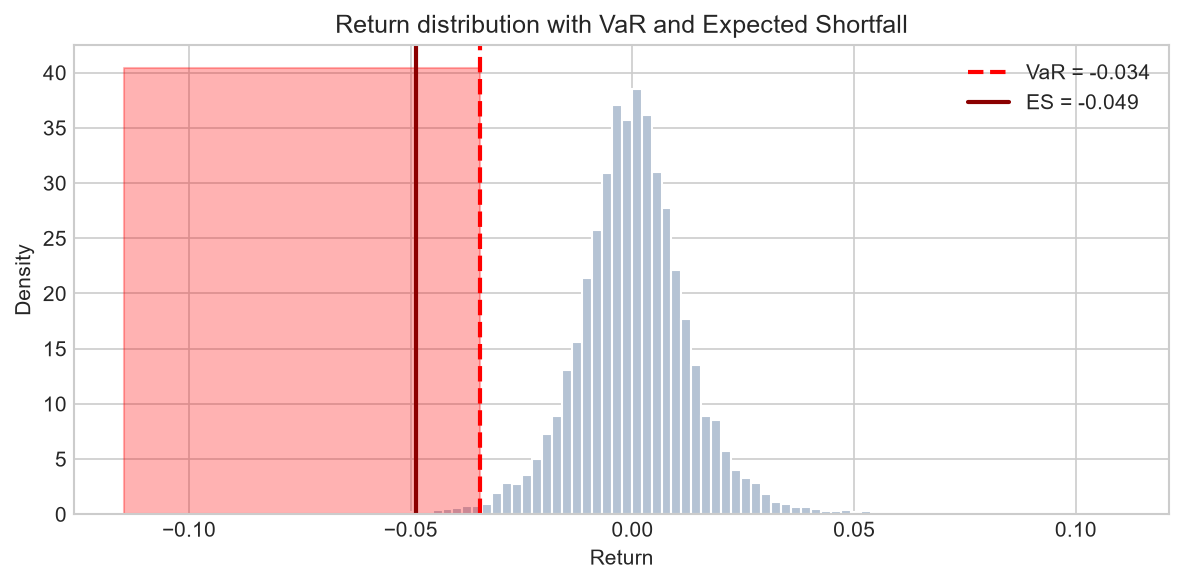 Return distribution with VaR and Expected Shortfall
The appeal of VaR is that it compresses risk into a single number; the danger is that the number is easily manipulated and hard to interpret. Alter the horizon, the confidence level, or the method, and the same portfolio returns a different VaR. Worse, VaR says nothing of how bad the bad days grow: a portfolio may hold a modest VaR and remain capable of catastrophic loss.
Expected Shortfall, called also Conditional VaR, remedies part of this. It is the average loss conditional on exceeding the VaR threshold; it satisfies coherence properties that VaR lacks and punishes tail risk more directly. Regulators moved toward it with good reason, yet it remains a statistical summary, not a guarantee.
Estimation methods fall into three camps. Historical simulation takes past returns directly. Variance-covariance assumes a normal distribution with estimated moments. Monte Carlo simulates from a chosen model. Each has its weakness: historical simulation cannot foresee the unprecedented; variance-covariance misses fat tails; Monte Carlo depends upon the model being right.
Backtesting is indispensable. Count the VaR breaches and set them against the expected frequency. Too many, and the model understated risk; too few, and it overstated risk and tied up capital. A model that passes a backtest is not thereby correct, but a model that fails one is assuredly wrong.
In fast markets correlations spike and liquidity vanishes; a VaR reckoned in calm conditions becomes a fiction. For this reason Stress Testing and Scenario Design stands beside the statistical measures. A sound framework uses VaR for everyday sizing and stress testing for the days that break the model.
Risk metrics serve only if they drive decisions. A desk that reports VaR yet does not trim positions as VaR rises is performing theater. The mathematics is the easy part; the discipline is the hard one.