Volatility Modeling with GARCH [/ˌvɑləˈtɪləti ˈmɑdəlɪŋ wɪθ ˈgarkh/] n - Volatility clusters: large moves follow large moves, and quiet periods follow quiet periods. Upon that observation rests GARCH and its kin. The model holds that today’s variance depends upon yesterday’s variance and yesterday’s squared return:
The persistence is ; a sum near one means shocks decay slowly.
The clustering is visible in any return series:
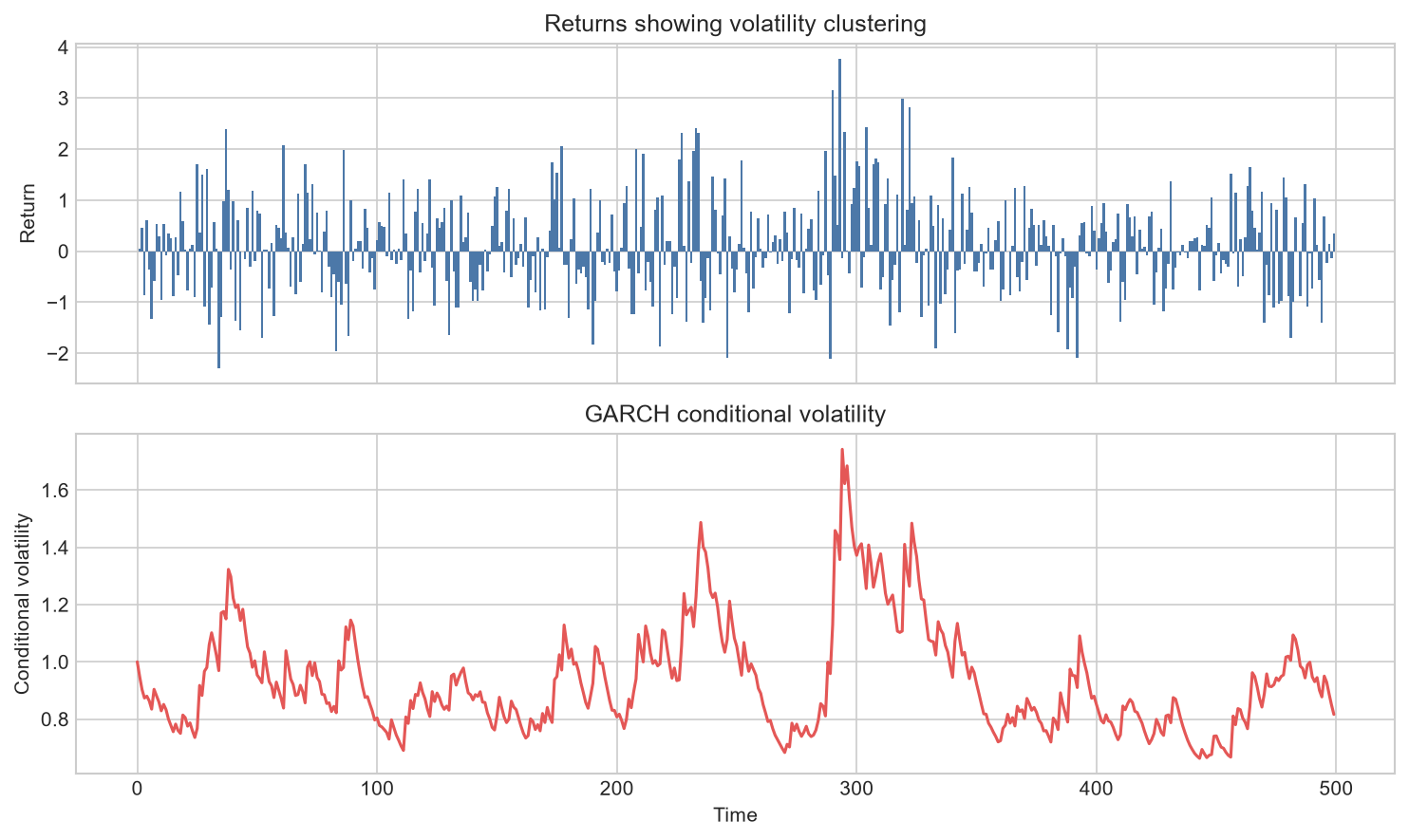 GARCH volatility clustering
That persistence, alpha plus beta, tells how long a volatility shock lingers. A sum near one is true to financial markets yet perilous for forecasting, for the model remembers old shocks overlong and can miss a change of regime.
GARCH serves well for one-day or one-week volatility forecasts; its usefulness fades as the horizon stretches, for mean reversion in variance comes to dominate. The long-run variance estimate usually outweighs the short-term update. Traders who reach for GARCH in monthly option pricing are oft better served by a simple long-run average with skew adjustments.
The standardized residuals of a GARCH model should be inspected. If they still show clustering or skew, the model is incomplete. Extensions such as EGARCH capture asymmetric effects: the leverage effect, whereby negative returns raise future volatility more than positive ones. GJR-GARCH does the same by way of a threshold; stochastic volatility models go further still, treating variance as its own random process.
A common misuse is to model raw price volatility in place of return volatility. Price levels trend; returns stand closer to stationary. Always confirm that the series you model bears the properties the model assumes.
GARCH forecasts are inputs, not strategies. A forecast of high volatility says nothing of direction; it speaks to position size, option premium, and the width of your stops. The work lies in joining GARCH to a directional signal. A good model sizes down when uncertainty runs high and sizes up when the edge is clean.
Out-of-sample testing matters above all for volatility models; in-sample fit deceives, for the model has seen the very shocks it purports to explain. Walk-forward tests, judged by economic metrics such as option P&L or Value at Risk violations, are the only way to learn whether the model matters. See Value at Risk and Expected Shortfall for how variance forecasts feed risk measurement, and EWMA and RiskMetrics for a simpler one-parameter alternative.