EWMA and RiskMetrics [/ˈewma ənd ˈriskmetriks/] n - An exponentially weighted moving average is a one-parameter contrivance for granting recent observations the greater voice. Recent days govern the estimate, while older ones fade like writing on a palimpsest:
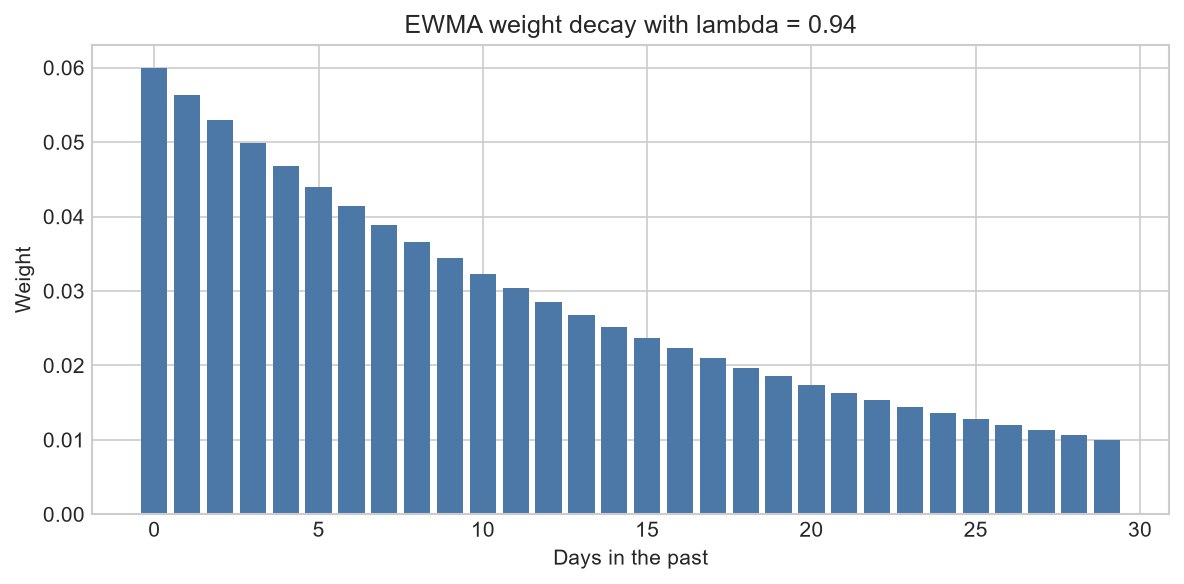 EWMA weight decay
The recursion is:
is the decay factor, commonly close to one. A value of 0.94 implies a half-life of roughly eleven days. A smaller renders the estimate more responsive to recent events; a larger one makes it smoother.
RiskMetrics made EWMA famous for the management of risk. A portfolio covariance matrix may be updated in the same manner:
The matrix update is swift and asks for no optimization, which commends EWMA for high-dimensional portfolios where fitting a full GARCH model would prove slow or unstable.
The defect is rigidity. EWMA knows no mean reversion; after a volatility spike, the forecast decays exponentially toward the long-run average at a fixed pace. GARCH adds a long-run variance target and can reckon more truly over longer horizons. See Volatility Modeling with GARCH for the comparison.
EWMA also weighs positive and negative shocks alike. In equities, a large negative return commonly raises future volatility more than a positive return of equal size, so a desk concerned with downside risk may find EWMA understating the left tail.
The decay parameter should be chosen for the horizon, not for the modeler’s intuition; a one-day risk forecast and a one-month risk forecast want different lambdas. Walk-forward testing is the only honest way to choose. In practice, a decay factor of 0.94 for daily variance endures as a starting point because it works, not because it is optimal.