Time Series Decomposition and Forecasting [/ˈtaɪm ˈsɪriz ˌdikəmpəˈzɪʃən ənd ˈfɔrˌkæstɪŋ/] v - Every time series is a stack of stories, and the work of decomposition is to pull the stories apart so that each may be forecast honestly. Most failures in quantitative prediction come not from bad models but from modeling the wrong component.
The classical breakdown is additive:
Trend is the long-term direction. Seasonality is the calendar regularity. Cycle is the slower, non-calendar oscillation. Error is everything else, and in financial data it is in the error term that the money is usually lost.
A stylized decomposition looks like this:
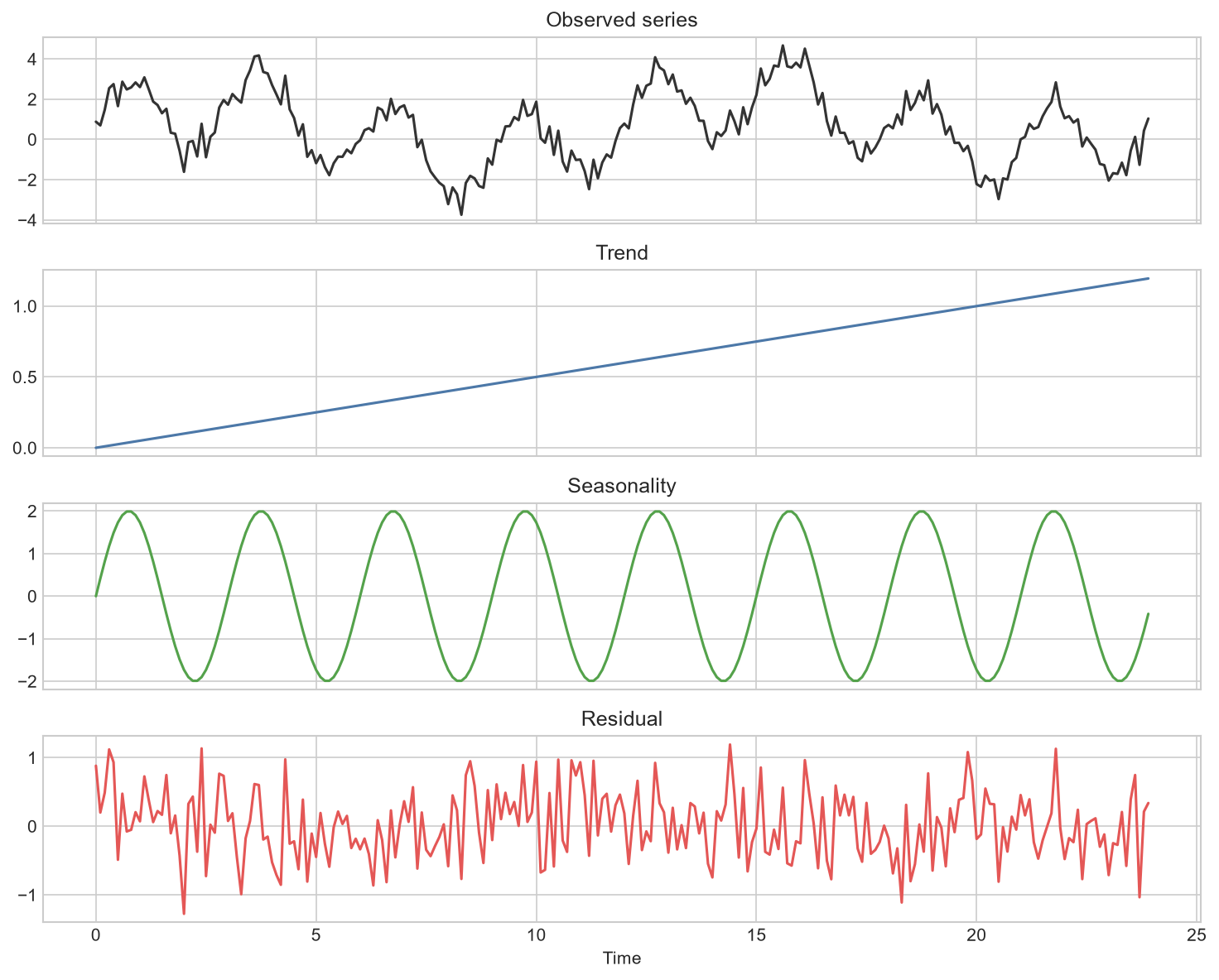 Time series decomposition
The residual layer is where your time is best spent. If it is not white noise, the decomposition is incomplete.
Trend is easy to describe and hard to trade. A stock may wear the semblance of a trend for years, then surrender five years of gains in six months. The trend component seduces because it draws smooth lines on a chart; smoothness is not alpha.
Seasonality in markets is real but small and crowded. The January effect, turn-of-the-month patterns, and options expiration cycles have been harvested, arbed, and regressed to noise. You may still find them, but the margins are thin and the capacity is limited.
Cycles are the dangerous middle. Business cycles, credit cycles, and inventory cycles matter, yet their periods drift and their phases are plain only in retrospect. A fixed-frequency cycle model will look brilliant until it does not.
Decomposition should precede model selection. If the series is non-stationary, transform it; Stationarity and Unit Root Tests records the tests that tell you whether differencing is needed. If it carries heteroskedasticity, model the variance first: Volatility Modeling with GARCH and EWMA and RiskMetrics treat of variance, while ARIMA and Conditional Mean Models and Seasonal ARIMA and Exponential Smoothing treat of the conditional mean once the series is clean.
The practical test of a decomposition is whether it improves out-of-sample forecasts; in-sample fit is nearly worthless in this business. A decomposed model that looks pretty on a chart but fails in walk-forward testing is a hobby, not a strategy.
Good forecasters spend more hours staring at residuals than at fitted values. Residuals tell you what the decomposition missed, and missed structure in residuals becomes the next model, or the next reason to stop trading.