ARIMA and Conditional Mean Models [/ˈarima ənd kənˈdɪʃənəl ˈmin ˈmɑdəlz/] n - ARIMA is the gateway drug of quantitative forecasting. It offers a compact means of modeling persistence in a time series: autoregressive terms hold memory, moving-average terms hold shocks, and differencing disposes of non-stationarity. The model is elegant, well understood, and mostly wrong for financial returns.
The fault lies not in the mathematics but in the thing modeled. Returns are nigh to martingale differences, and the best forecast of tomorrow’s return is oft near zero. An ARIMA model will find small autocorrelations, fit them, and render a forecast that is statistically significant and economically meaningless.
This does not leave ARIMA useless. It serves well in foretelling the predictability of volatility, of spreads, of mean-reverting state variables, and it serves as a benchmark: if your neural net cannot beat a simple ARIMA on a mean-reverting spread, the neural net adds nothing.
Before fitting an ARIMA model, see that the series is appropriately differenced and that the residual autocorrelation structure is clean. See Stationarity and Unit Root Tests and Autocorrelation Function and Partial Autocorrelation for the diagnostics. The compact ARIMA(p,d,q) form is:
The autoregressive side captures memory, the differencing operator removes trends, and the moving-average side absorbs shocks. The equation looks more impressive than the forecast usually is.
Parameter selection matters more than most practitioners will own. An ARIMA(2,1,2) fitted to the same data by two different information criteria can yield materially different forecasts, and the standard errors widen quickly beyond the estimation window. In finance the instability of the parameters is oft larger than the signal.
A useful diagnostic is the autocorrelation function of the residuals. For a return series one hopes to see something near white noise:
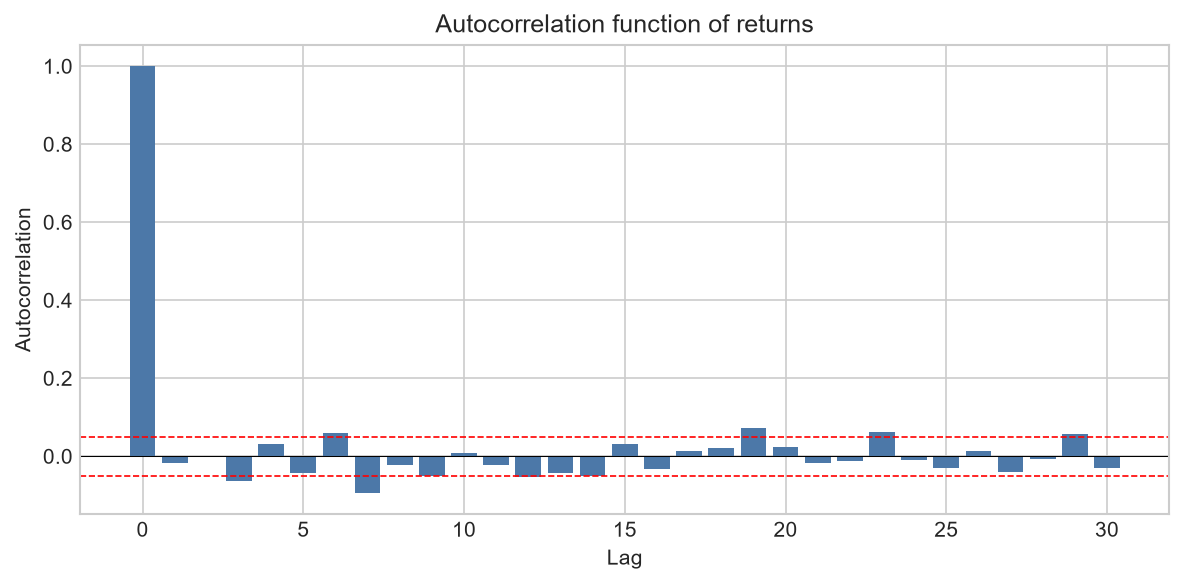 Autocorrelation of returns
Small, sporadic spikes can be fit by an ARIMA, yet they seldom survive trading costs.
Conditional mean modeling reaches beyond ARIMA. Explanatory variables, interaction terms, and non-linear links enter by way of regression, GARCH-in-mean, or state-space forms; the core discipline is unchanged: model only what is forecastable, and measure the forecast error honestly.
A common error is to model prices rather than returns. Prices are non-stationary by construction, and a forecast of next week’s price level is usually a forecast of next week’s random walk plus drift. Model returns, or model the log-price as a cointegrated system; see Cointegration and Pairs Trading for the multivariate case.
For data with strong seasonal patterns, ARIMA is extended to SARIMA. See Seasonal ARIMA and Exponential Smoothing.
The honest use of ARIMA in trading is as baseline and diagnostic. It tells you whether the persistence you fancy you see survives a simple representation. If it does not, your elaborate model is likely embroidery upon noise.