Cointegration and Pairs Trading [/ˈkointegraʃən ənd ˈpɛrz ˈtreɪdɪŋ/] v - Cointegration is the statistical guise of a bond that common sense already knew. Two companies in one industry, subject to the same cost of capital and the same shocks of demand, ought not wander from each other forever. Should their prices wander, the spread itself becomes a tradeable quantity: long the cheap, short the dear, and abide the convergence.
The mathematics rests upon this: a linear combination of non-stationary series may yet be stationary. If and are both , there may exist a such that:
That is the hedge ratio. The stationarity of is what renders the spread mean-reverting.
A cointegrated pair presents itself thus:
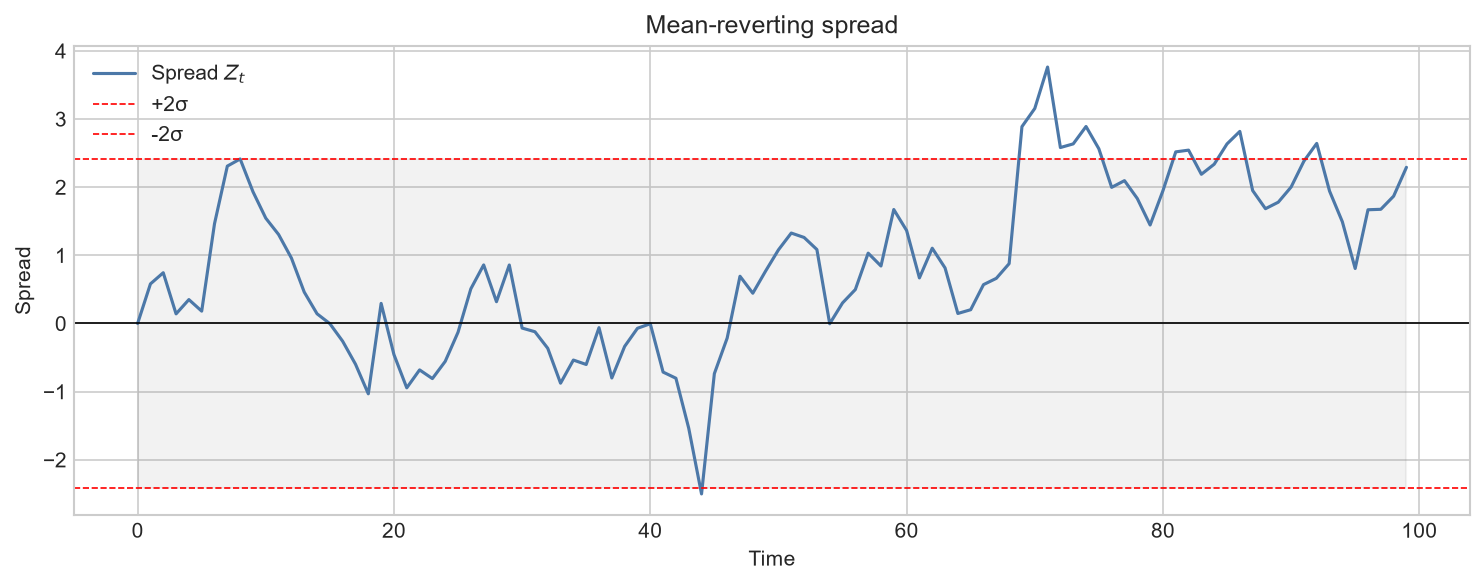 Mean-reverting spread
The dots touch the bands and rebound toward zero. A series that does not rebound is no trade; it is a drift.
To test for cointegration is harder than to test a series for stationarity. The Engle-Granger two-step method is simple, yet sensitive to which variable one normalizes upon. Johansen’s procedure is more symmetric and admits multiple series, but it overfits readily. A cointegration test that passes on one subsample and fails upon another is a coin flip, not an edge.
The classic pairs trade has been squeezed by efficiency and by crowding. When too many desks run the same pairs, the spreads grow smaller and the unwinds sharper. The easy part is finding cointegration. The hard part is finding cointegration that endures transaction costs, funding, and a change of regime.
The half-life of mean reversion is the number that matters. A spread with a half-life of months is a position, not a trade. A spread with a half-life of days is commonly noise dressed as signal. Capacity constrains likewise: the capital that can pass through a small pair without moving its price is bounded.
Cointegration generalizes to portfolios and factor structures; a portfolio may be cointegrated with an index or a synthetic benchmark. The tools are the same, but the risk is greater, for the divergence may last longer and wound deeper.
When pairs trading fails, it fails most oft because the underlying economics shifted: a merger, a pivot of business model, a permanent shift in relative valuation breaks the cointegrating bond, and the math cannot see it coming. Regime Switching and Hidden Markov Models and Alpha Decay and Model Lifecycle are the pages where that reality is managed.