Alpha Decay and Model Lifecycle [/ˈælfə dɪˈkeɪ ənd ˈmɑdəl ˈlifesykle/] n - Alpha decay is the half-life of an edge. A strategy that served last year may serve this year, or it may be arbed away, crowded, or made obsolete by a change in market structure. Decay is no bug; it is the normal state of a competitive trade.
The speed of decay follows the source of the edge. A behavioral anomaly, easy to grasp and cheap to implement, decays fast. A signal that wants proprietary data, sophisticated processing, and careful execution decays more slowly. A genuine structural inefficiency, some regulatory constraint that bars certain participants from trading, can endure for years.
Crowding hastens decay. When many desks run the same signal, the profit per dollar of capital falls. Worse, crowding breeds tail risk: if all try to leave the same trade at the same hour, the unwind is violent, and a strategy that seemed benign in isolation turns systemic in a crowded exit.
To watch for decay one needs live diagnostics. Track realized return against expected for each signal. Track the correlation between your trades and kindred strategies. Track the capacity of the strategy against the volume it touches. The first sign of decay is oft a widening gap between backtest and live performance.
The answer to decay is a lifecycle. Strategies pass through stages, and each transition should be gated:
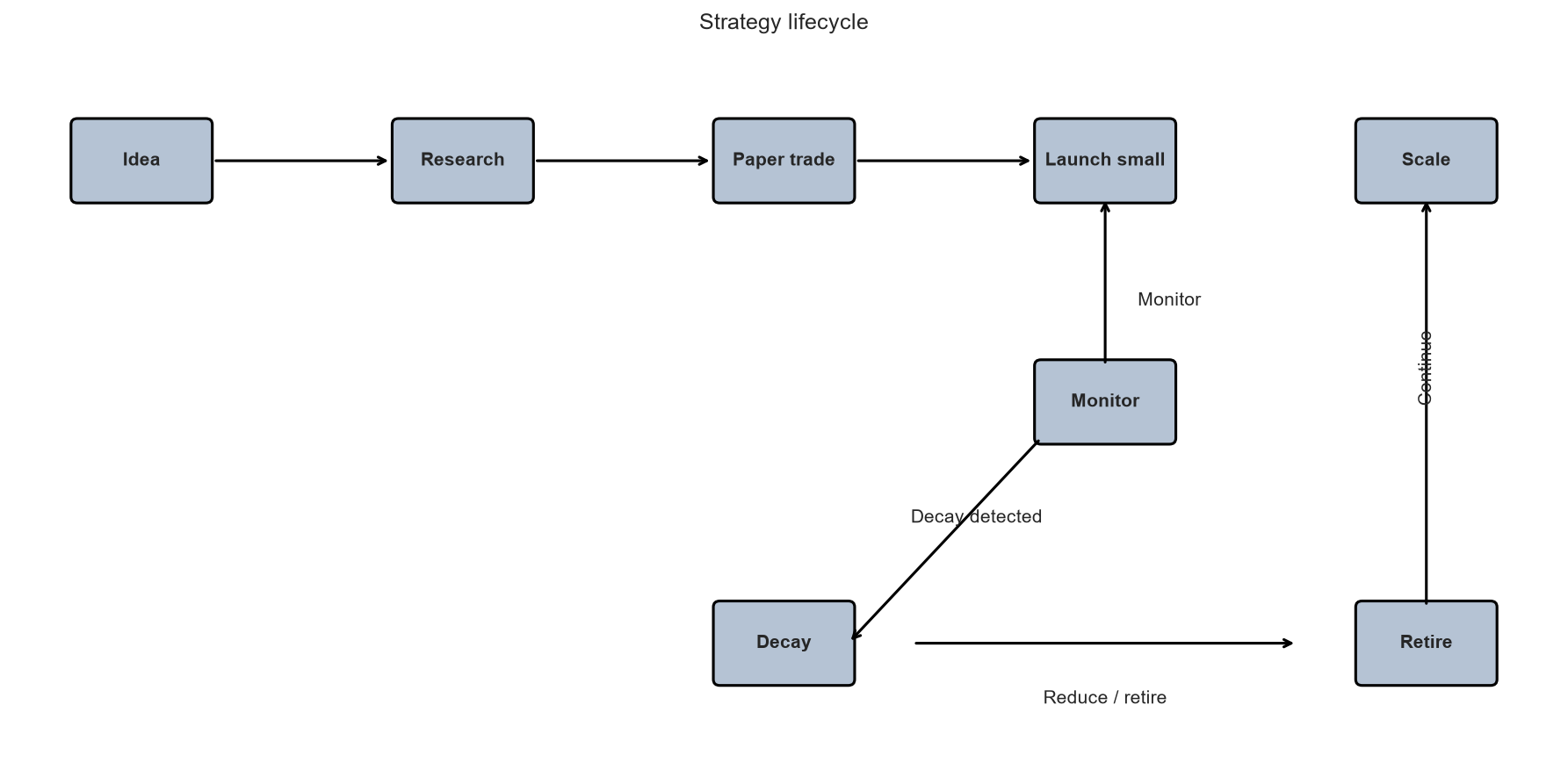 Strategy lifecycle
Each stage has its criteria. A strategy that fails its launch criteria does not scale; one that breaches its decay criteria is wound down.
Retirement is part of the work. A trader who cannot retire a strategy will watch it drift from positive to negative expected return while hoping for its return to life, and that hope is costly. The capital freed by retiring a stale strategy should fund new research.
Research itself must renew. A firm that ceases to generate ideas will in time run out of working strategies; the pipeline should yield more candidates than can be launched, so the portfolio may be refreshed. See The Quantitative Research Workflow for how that pipeline is ordered.
The mathematics of decay matters less than the discipline of response. You need not predict the hour an edge dies. You need a process that limits the damage when it does.