Feature Engineering for Predictive Signals [/ˈfiʧər ˈɛnʤəˈnɪrɪŋ fər prɪˈdɪktɪv ˈsɪgnəlz/] n - Feature engineering is where a quant earns his keep. A model finds only what the features encode; if the inputs are unstable, irrelevant, or tainted with lookahead bias, the most sophisticated algorithm will yield garbage.
The first principle is economic meaning. A feature should answer to something real: a behavioral tendency, a liquidity imbalance, a slow diffusion of information, a risk premium. A black-box transformation of prices may shine in backtest and signify nothing in production.
The second is stability. A feature that works in one regime and inverts in another is dangerous. Instability betrays itself in rolling correlations, regime tests, or a plain plot of the feature against forward returns across the years; if the relationship changes sign, the feature is not ready for a live model.
Normalization matters. Prices vary across assets by orders of magnitude, so a raw price level is no feature; a rank, a z-score, or a percentile is. Cross-sectional ranking within a universe strips out scale effects and renders the signal comparable across names.
Lookahead bias is the silent killer. Any feature that uses information unavailable at the decision time will produce spectacular backtests: closing prices predicting the same close, adjusted prices before the adjustment is known, fundamental data filed after the period it describes. Trade always at the timestamp the feature is known.
A correct timestamp alignment looks like this:
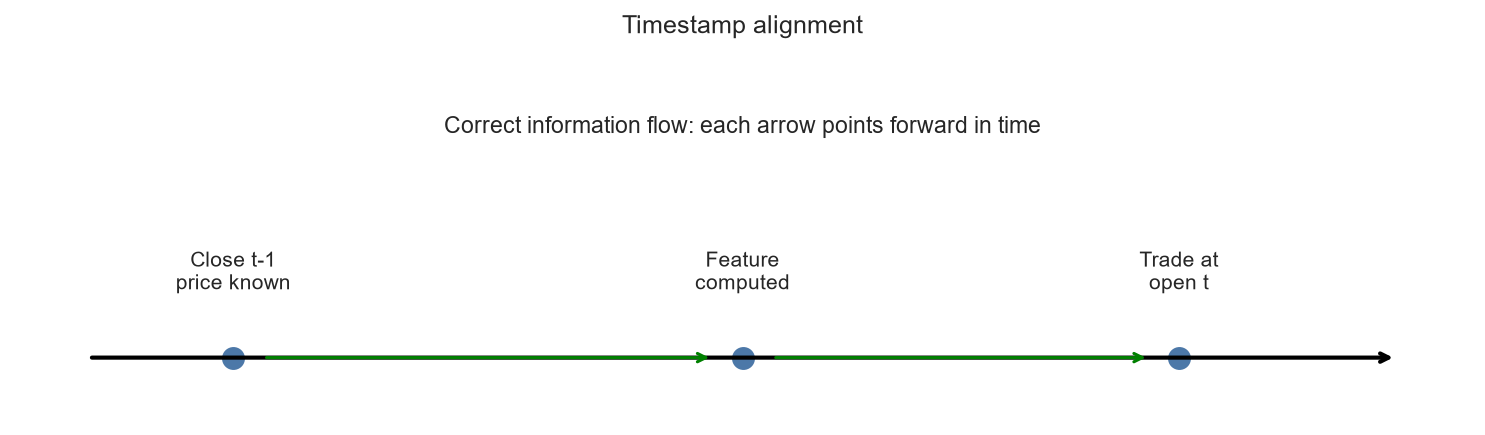 Timestamp alignment for lookahead bias
If the arrow from “feature computed” points backward, the backtest is fiction.
Interaction features can be powerful, yet they multiply the search space. A momentum feature and a volatility feature may each be weak while their interaction is strong; but testing thousands of interactions invites multiple comparison bias. See Backtesting and Multiple Comparison Bias for the controls.
Dimensionality reduction helps when features are correlated. Principal components extract common factors; autoencoders learn nonlinear compressions. The danger is that the reduced space loses the very signal you cared about. A compact representation serves only if it preserves predictability.
Features decay. What worked in 2010 may fail in 2025. Monitoring live performance and retiring stale features belongs to Alpha Decay and Model Lifecycle. A good feature library is curated as a portfolio is: additions deliberate, old positions closed.
The last test is whether the feature improves an existing model. A great univariate relationship that adds nothing multivariately is usually a proxy for something already captured; the marginal contribution is what counts. See Information Coefficient and Signal Decay for how to measure and watch that contribution over time.