Linear Factor Models in Trading [/ˈlɪniər ˈfæktər ˈmɑdəlz ɪn ˈtreɪdɪŋ/] v - A linear factor model is the first lie a quant tells with a straight face. It says the return of an asset is a weighted sum of a few common drivers, plus noise. The lie is useful: it parts what you are paid to hold from what you fancy you know.
The canonical form is simple:
Stacking the assets and factors gives the matrix form:
Alpha is the residual you claim as skill. Betas are exposures you could have bought for almost nothing. Epsilon is what remains, and most of the time epsilon is where the true story dwells.
It helps to split a stock’s return into what the factor model explains and what it does not:
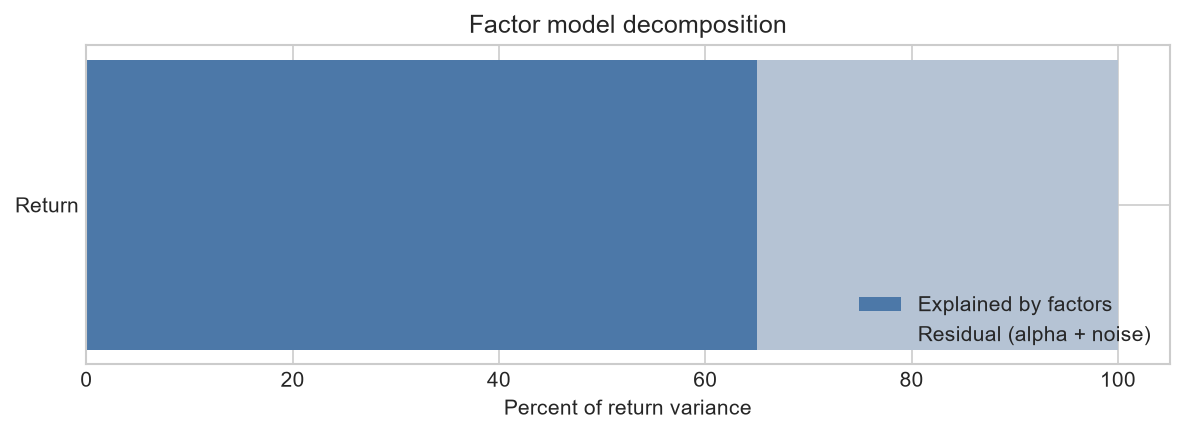 Factor model return decomposition
The explained bar is the cheap, commoditized part. The residual bar is where the argument lives.
In practice the factors F are value, momentum, size, quality, volatility, carry, or any curated set that explains covariance. The regression is run over a window, the betas estimated with error, the residuals screened for alpha. If the alpha endures out of sample, you may have something. More often you have a factor you forgot to include.
The real work is not the regression but the choice of factors. A model with the wrong factors gives clean t-statistics on noise; a model with too many gives overfit betas and a false sense of diversification. The seasoned quant spends more hours arguing what belongs in F than reckoning the coefficients.
Residualization matters. A signal that predicts raw returns may vanish once industry, beta, or liquidity effects are removed; the signal that predicts residuals is the one worth a position. This is why Feature Engineering for Predictive Signals and Machine Learning Alpha Models are problems apart from factor construction.
Factor models also fail across regimes. A value factor that serves for fifteen years can spend a decade in drawdown; the betas themselves move. See Regime Switching and Hidden Markov Models for what to do when the model you fit no longer fits the world.
Linear factor models are a starting point, not a strategy. They teach what you are exposed to. The edge lies in knowing what the model leaves out.