The Quantitative Research Workflow [/ðə kˈwɑntɪˌteɪtɪv ˈrisərʧ ˈwərkˌfloʊ/] n - A quantitative research workflow is a pipeline for turning ideas into strategies and strategies into managed portfolios. It is easy to describe and hard to execute, for every stage has incentives to conceal its problems.
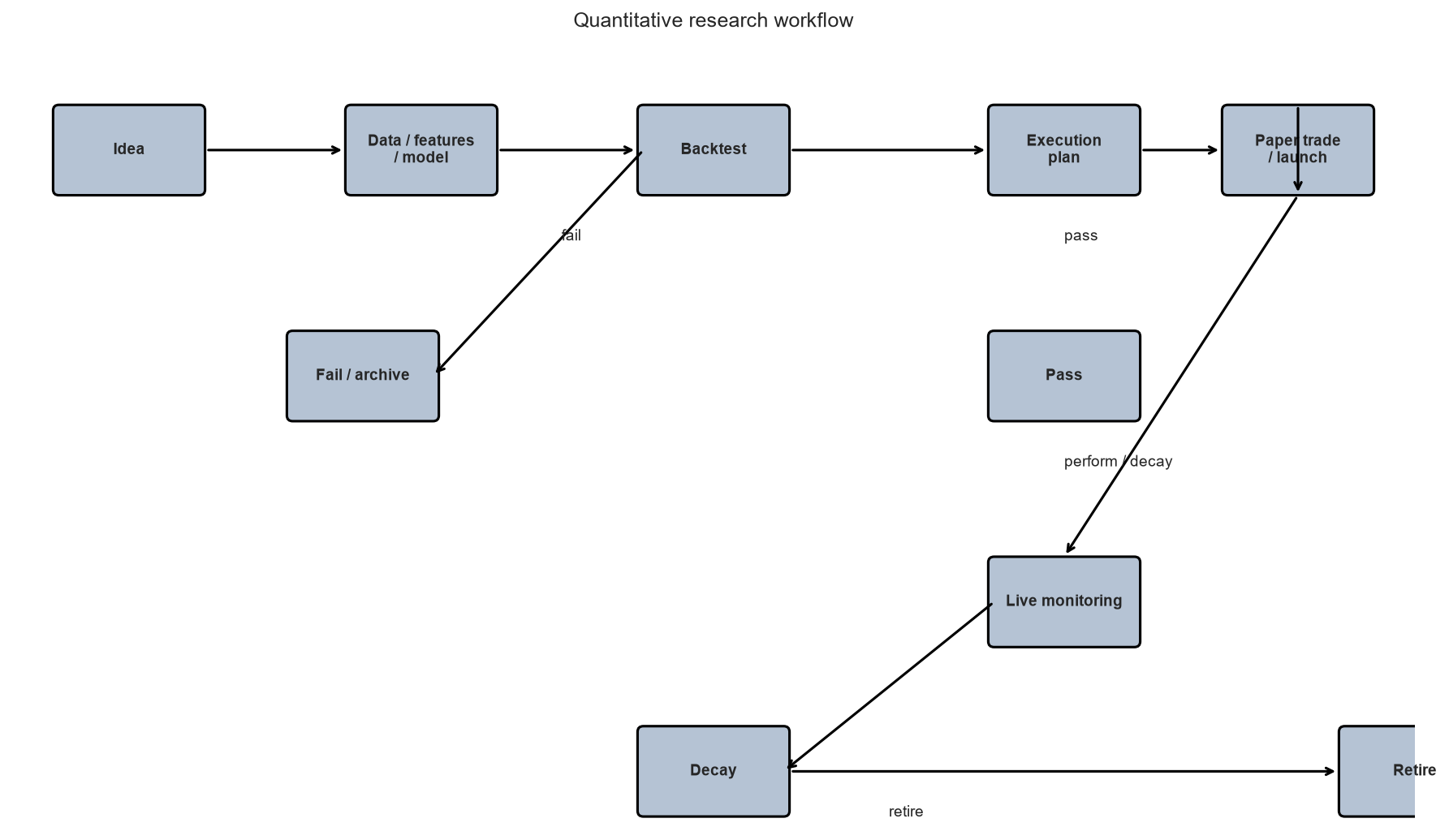 Quantitative research workflow
A clean handoff between stages is what divides a hobby from a production strategy.
The work begins with idea generation. Ideas arise from market observation, academic literature, conversations with traders, and now and then pure speculation. The discipline is to write the idea down in falsifiable form before touching data. If you cannot state what would prove the idea wrong, you are not doing research; you are mining.
Data collection and cleaning consume more time than most expect. Raw data is messy: bad ticks, missing values, corporate actions, splits, dividends, delistings. A strategy that looks brilliant on dirty data usually dies on clean data. Every transformation must be timestamped and audited.
Feature and model development is where the technical labor dwells. The tools come from the rest of these pages: Linear Factor Models in Trading, ARIMA and Conditional Mean Models, Machine Learning Alpha Models, and others. Keep the model simple until the data compels complexity.
Backtesting is the gate; see Backtesting and Multiple Comparison Bias for how to keep it honest. A strategy that fails here should not advance, and no telling of stories can rescue a bad backtest.
Implementation planning covers execution, technology, and operations. How will orders be generated? Which broker or exchange? What is the latency budget? How will the strategy be watched? See Market Microstructure and Execution and Market Impact and Optimal Execution. A model without an implementation plan is a paper.
Paper trading and small-scale launch test the assumptions. Does the live P&L match the backtest? Are fills worse than expected? Does the strategy comport itself strangely around market events? This stage oft reveals what no simulation can catch.
Production monitoring is continuous. Track P&L, risk metrics, turnover, and the underlying signals; compare live performance to the expected distributions. If the strategy underperforms longer than the predetermined threshold, investigate or de-risk.
Retirement is the final stage. A strategy is shut down when it no longer meets its criteria; see Alpha Decay and Model Lifecycle. The capital is redeployed into newer research, and the cycle begins again.
A strong workflow is boring by design: it makes the failures cheap and the successes reproducible. The best quant firms are not those with the most exotic models, but those with the most disciplined process.