Market Microstructure and Execution [/ˈmɑrkɪt ˈmikrostruktʃər ənd ˌɛksəˈkjuʃən/] n - Market microstructure is the study of how prices are in truth formed; it stands between the theory of efficient markets and the fact of order books. For a predictive trader it decides whether a forecast can be turned into P&L.
The bid-ask spread is the first cost. A signal foretelling a one basis point move is worthless where the spread is two. Spread shifts with volatility, with the hour of the day, with stress; to ignore it is to turn a winning backtest into a losing strategy.
Depth matters as much as spread. A thin book absorbs little before the price gives way, and a backtest that presumes you may trade at the midprice at any size is fiction. To reckon true cost you want either proprietary execution data or a microstructure model.
A stylized order book shows the trouble:
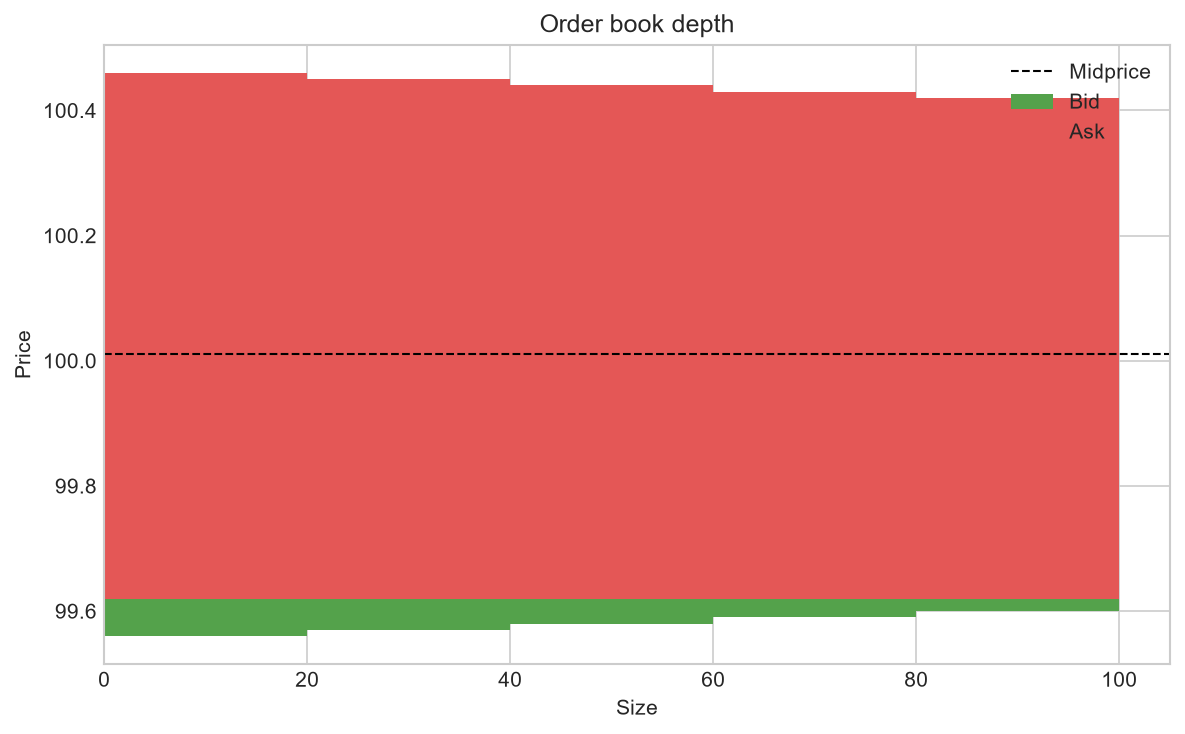 Order book depth
A 250-lot buy in this book walks the ask from 100.02 to 100.05; the average fill falls short of the mid by an amount set by the total quantity and the book’s shape.
Order flow is informative. Aggressive buyer-initiated trades tend to be followed by further pressure, at least for a while; yet the information decays swiftly, sometimes within seconds or minutes. To capture it demands fast data and a clear reckoning of how long the signal endures.
Market impact is the bridge from microstructure to execution. When your order moves the price, you pay more than the spread. Impact has a temporary part, which dissipates, and a permanent part, which alters fair value; to estimate both is essential to Market Impact and Optimal Execution.
Latency, too, is microstructure in high-frequency strategies. A slow signal may serve if it persists for days; a fast one is useless if you cannot act before it decays. Co-location, feed handlers, and order gateways are not mathematics, but they decide whether the mathematics pays.
Tick sizes, lot sizes, and trading halts impose a discreteness that continuous models overlook. A price that cannot trade between ticks behaves otherwise than a continuous diffusion, and in stressed markets circuit breakers and auction periods govern all.
The honest quant treats execution as a first-class problem. A model without an execution plan is a research result; a model with one is a strategy. Backtests should carry conservative assumptions of slippage, rejection rates, and partial fills. See Transaction Costs and Slippage Models for the taxonomy of costs, High-Frequency Data and Tick Analytics for the data side, and Backtesting and Multiple Comparison Bias for how to keep assumptions from hardening into fantasy.