Market Impact and Optimal Execution [/ˈmɑrkɪt ˌɪmˈpækt ənd ˈɑptɪməl ˌɛksəˈkjuʃən/] n - Every trade moves the market against you. The question is never whether you pay impact, only how much. A quant strategy that ignores impact is a fantasy with a Sharpe ratio affixed.
Impact divides into temporary and permanent parts. Temporary impact is the concession exacted to find liquidity now; it recovers as the book refills. Permanent impact is what your order reveals of fair value, by information or by pressure; it does not return. To part the two asks careful study of post-trade price paths.
The square-root law is a durable rule of thumb. If is the order size and the average daily volume, impact scales as:
where is daily volatility and a market-dependent constant. It is no theorem, yet it stands nearer the truth than any linear model. A trade of ten percent of daily volume costs far more than twice one of two and a half percent.
Optimal execution algorithms spread an order across time to lessen impact. A time-weighted average price order participates evenly; a volume-weighted average price order follows the expected volume profile; implementation shortfall algorithms weigh expected cost against price risk, oft by dynamic programming. Each presumes some model of price dynamics and liquidity.
The Almgren-Chriss framework is the textbook starting place. It minimizes a cost function of the form:
where is the trading rate, and are market-impact parameters, the variance of the asset, and risk aversion. The framework weighs market impact against variance risk and yields an optimal trajectory. In practice the parameters are hard to estimate, and the model is blind to much that is real: discrete time, partial fills, shifting liquidity.
A typical optimal execution trajectory begins fast and ends slow, balancing impact against price uncertainty:
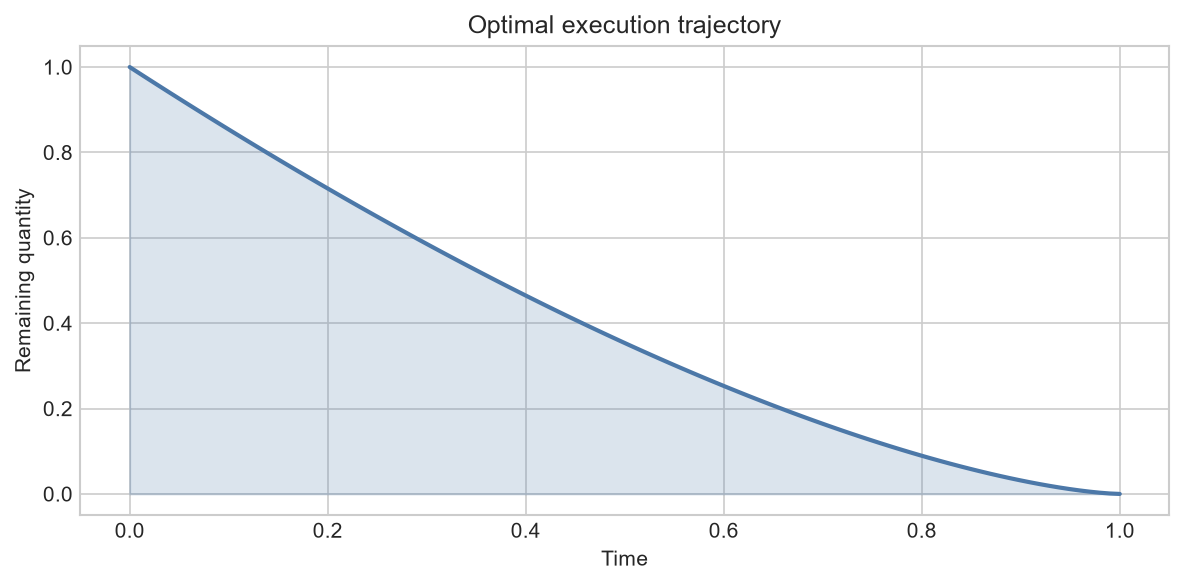 Optimal execution trajectory
Adaptive algorithms answer realized liquidity. If the spread tightens, trade faster; if liquidity dries, slow or stop. Adaptivity carries its own perils: an algorithm too reactive can be gamed, and one too passive lets the opportunity slip.
Execution cost belongs to the whole cost of a strategy: explicit commissions, implicit spread and impact, and the opportunity cost of orders unfilled. A strategy of high expected alpha and high impact may prove inferior to one of modest alpha and low impact.
The only honest trial of execution is live performance. Simulations are educated guesses; a backtest with a fixed slippage assumption is a sensitivity analysis, not a forecast. Begin small, measure realized against expected, and true the model. Alpha Decay and Model Lifecycle governs execution models no less than alpha models.