Stationarity and Unit Root Tests [/ˈstationariti ənd ˈjunɪt ˈrut ˈtɛsts/] n - Stationarity is the assumption that a series does not change its statistical character as time passes. A stationary series keeps a constant mean, a constant variance, and an autocorrelation structure that depends only upon the lag, never upon the calendar date. Most forecasting models assume it; most raw price series violate it.
The first thing a quant examines is whether the level wanders. A wandering level commonly means the series bears a unit root. A unit-root process is not mean-reverting; shocks accumulate without end. The difference between a stationary and a non-stationary series is visible in the path:
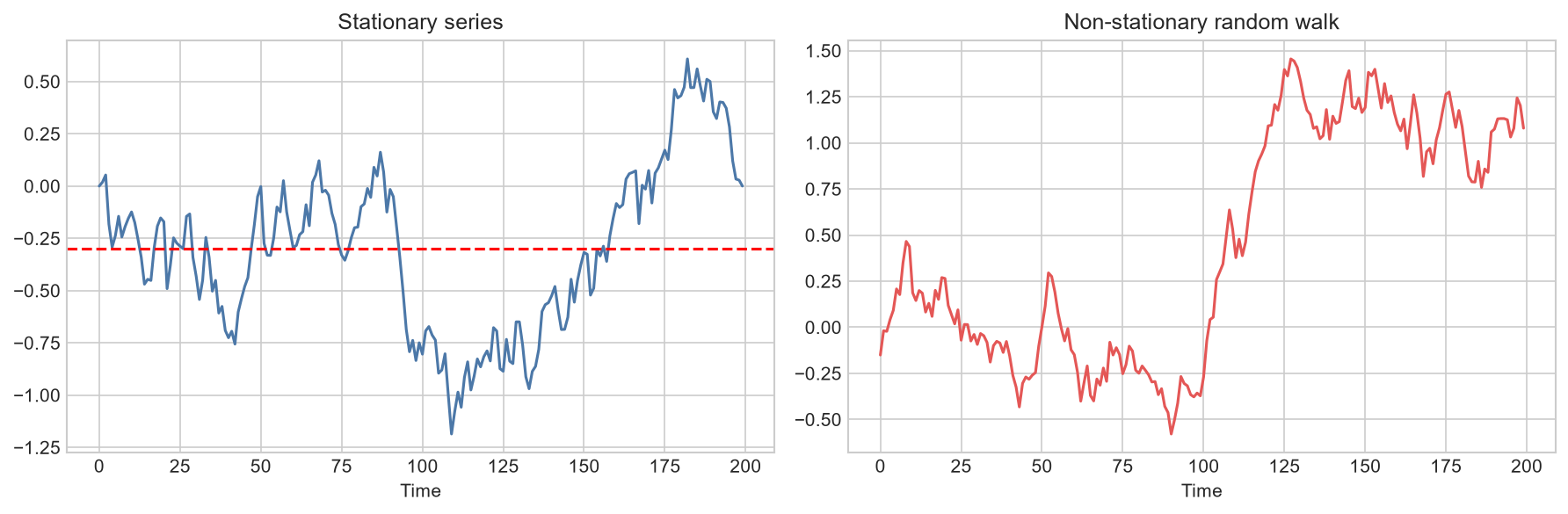 Stationary series versus random walk
Differencing is the standard remedy:
If one difference renders the series stationary, it is integrated of order one, written . Prices are typically ; returns lie usually closer to .
The Augmented Dickey-Fuller test is the commonest test. Its null hypothesis holds that the series has a unit root; a low p-value rejects non-stationarity. The test regression takes the form:
If is negative and statistically significant, the series reverts toward a mean.
The KPSS test reverses the logic: the null is stationarity, and rejection declares the series non-stationary. To run both together is good practice. If ADF rejects the unit root and KPSS fails to reject stationarity, you hold evidence for ; if they disagree, the series is likely more complicated than a simple unit root.
Structural breaks confound the assumptions of both tests. A series stationary about a shifting mean will appear non-stationary if you ignore the break, and conversely a series with a one-time level shift can falsely seem to bear a unit root. Inspect the series visually, always, and consider break tests.
Non-stationarity is no mere technical violation. It means your model attempts to forecast a target whose mean is in motion, and the coefficients you estimate record historical relationships that may not hold tomorrow. ARIMA and Conditional Mean Models and Cointegration and Pairs Trading rest upon these transformations. If the stationarity assumption is false, the remainder of the model is built upon sand.