Seasonal ARIMA and Exponential Smoothing [/ˈsizənəl ˈarima ənd ˌɛkspoʊˈnɛnʃəl sˈmuðɪŋ/] v - Seasonality is a pattern that returns upon a fixed calendar schedule. In markets it shows itself in volumes, spreads, volatility, and sometimes in returns. To ignore it is to leave predictable variation in the residuals; to overfit it is to invent patterns that will not come again.
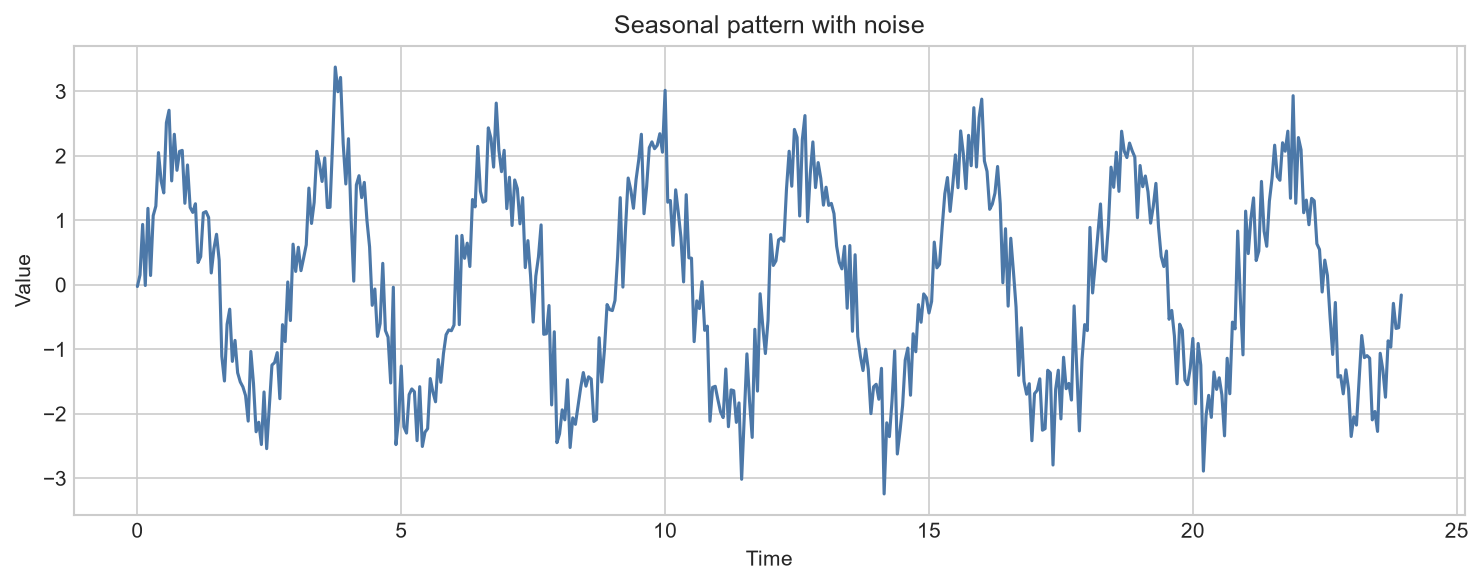 Seasonal pattern with noise
SARIMA extends ARIMA with seasonal terms, written SARIMA(p,d,q)(P,D,Q)m, where is the seasonal period. The expanded form for a simple seasonal difference is:
A series carrying both trend and seasonality may require regular differencing and seasonal differencing before it stands stationary:
Seasonal AR and MA terms capture correlation at the seasonal lag: a seasonal MA term at lag absorbs a shock that repeats once per cycle, and a seasonal AR term captures persistence there. They are easy to add, and easier to misuse.
Exponential smoothing is the rival family. Simple exponential smoothing forecasts the level; Holt’s method adds a trend; Holt-Winters adds a seasonal component. The updating equations are:
The smoothing parameters , , and govern how swiftly the model adapts. In fast-moving markets, high parameters track recent change yet chase noise; low parameters are stable but sluggish.
The honest trial of a seasonal model is out-of-sample accuracy upon fresh seasons. In-sample fit on seasonal data deceives, for the model can merely memorize the calendar. See Backtesting and Multiple Comparison Bias for why memorization is not a strategy.