The Black-Scholes Framework [/ðə ˈblakk-skholes ˈfreɪmˌwərk/] n - The Black-Scholes model is the lingua franca of derivatives. It yields a closed-form price for a European option under a brief list of assumptions: the underlying follows geometric Brownian motion, volatility is constant, there are no transaction costs, and markets are continuous. None of these is true; the framework endures because it is a robust quoting convention.
The Black-Scholes PDE governs the price of a derivative:
For a European call, the closed-form price is:
where
The formula matters less than the Greeks it produces; see The Greeks in Practice for the full set of sensitivities. Delta gives the equity-equivalent exposure. Gamma tells how fast that exposure changes. Vega measures sensitivity to implied volatility. Theta reckons the daily bleed. Together they let a desk manage a complex book as a set of simple exposures, and there the value dwells.
The volatility surface maps implied vol across strike and maturity. In practice it is never flat:
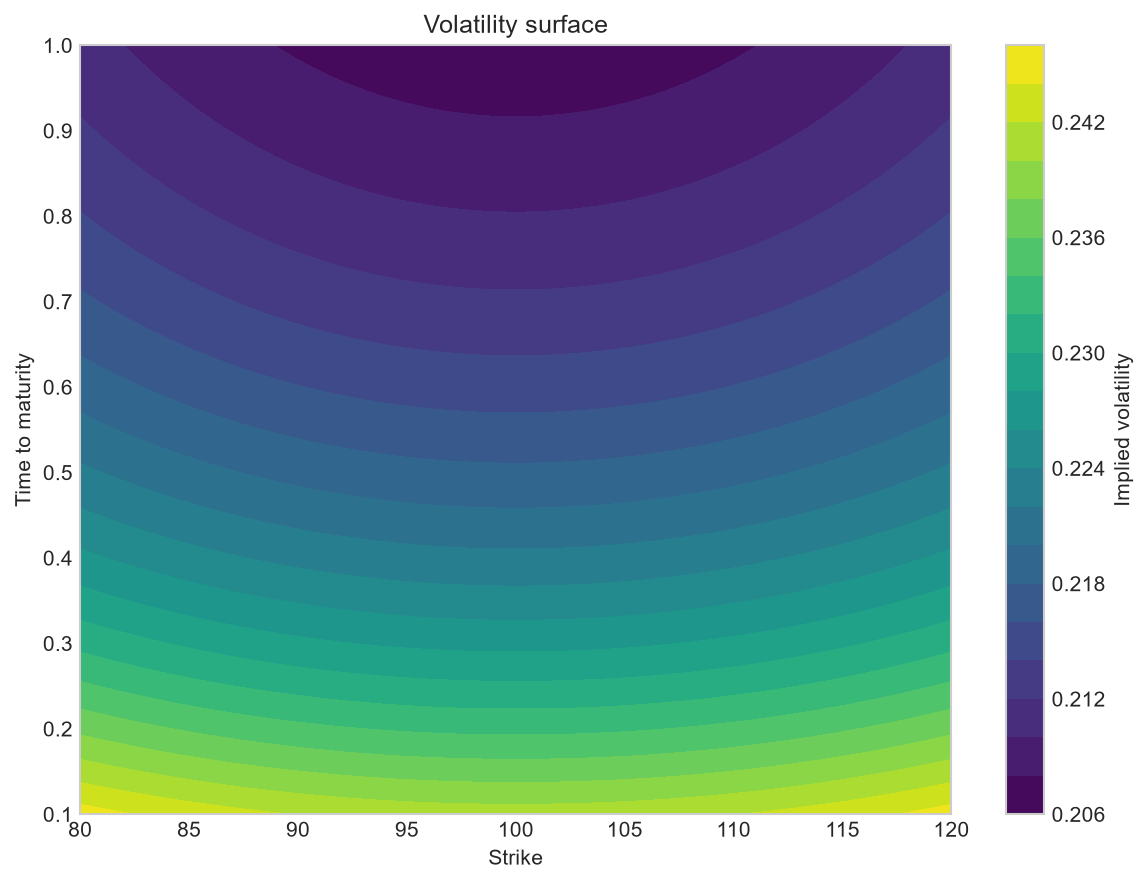 Volatility surface
Implied volatility is the great invention of Black-Scholes. By inverting the model, traders quote an option price as a volatility, transforming a dollar figure into a number comparable across strikes, expiries, and asset classes. The volatility surface, that map of implied vol across strikes and maturities, becomes the true object of study.
The model fails most visibly around events. Earnings, central bank announcements, and geopolitical shocks breed return distributions with fat tails and skew that constant-volatility Brownian motion cannot capture. The market answers by quoting skew and term structure; those are adjustments, not solutions.
For a predictive trader, Black-Scholes is a means of expressing a view with leverage and convexity. If you reckon a stock will move more than the market expects, you buy options and hope realized volatility exceeds implied. If you believe the contrary, you sell them. The forecast concerns the realized distribution; the pricing concerns the market-implied one. The edge lies in the gap.
Hedging in practice is discrete and costly. Rebalancing at every instant is impossible, so delta hedges slip. Transaction costs turn the theoretical arbitrage into a breakeven reckoning, and borrow fees, dividends, and funding rates draw the fair value away from the textbook number.
Black-Scholes should be respected as a benchmark and distrusted as reality; it is a starting point, the way a straight line is the starting point of a map. See Stochastic Calculus in Finance for the continuous-time foundation, and Volatility Modeling with GARCH for what follows when constant volatility is abandoned.