Stochastic Calculus in Finance [/stoʊˈkæstɪk ˈkælkjələs ɪn ˈfaɪˌnæns/] n - Stochastic calculus is the language of continuous-time finance. It lets you set down models in which uncertainty evolves in small, random steps, and in which the calculus learned in undergraduate physics no longer serves, for the paths are jagged.
The central result is Ito’s lemma. For a function of a stochastic process following:
the differential is not the chain rule alone. It carries a second-order term from the quadratic variation of Brownian motion:
That extra term is what sets option pricing apart from stock pricing.
A Brownian path is jagged enough that the second-order term does not vanish:
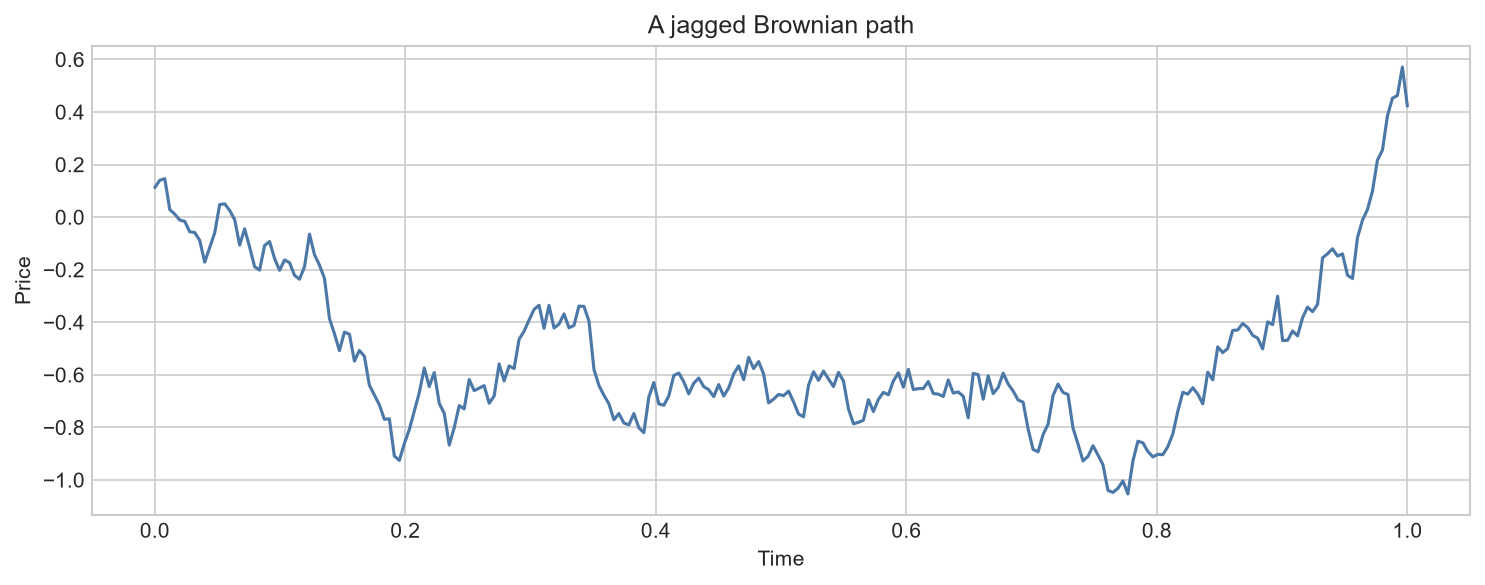 Brownian motion path
Most of the famous models are written as stochastic differential equations. Black-Scholes assumes geometric Brownian motion for the underlying; interest rate models add mean reversion; stochastic volatility models add a second factor that drives the variance itself. The mathematics grows ornate, yet the question is always the same: what distribution of outcomes does the model imply, and is that distribution priced aright?
For predictive trading, stochastic calculus is more scaffolding than signal. You do not need Ito’s lemma to forecast a factor; you need it to price the derivatives by which you express the view, to reckon the Greeks, and to hedge properly. A desk that predicts direction yet ignores convexity can be right about the market and lose money all the same.
The passage from discrete-time forecasting to continuous-time pricing is a common wellspring of error. A model estimated upon daily returns is not the same as a model used to price an option expiring in a month; time aggregation alters the dynamics. Jumps, which continuous-time models oft leave out, matter disproportionately for risk.
Simulation is the practical escape. When an SDE admits no closed-form solution, you discretize and run Monte Carlo Methods in Quantitative Research. The discretization error is real: Euler schemes drift, and subtler schemes trade bias for complexity. Check the convergence, always.
Stochastic calculus teaches humility. It formalizes that you cannot differentiate Brownian motion, that volatility accumulates with time, and that the future is a distribution rather than a point. A trader who takes that inward is less apt to trade a model as though it were a guarantee.