Monte Carlo Methods in Quantitative Research [/ˈmɑnti ˈkɑrloʊ ˈmɛθədz ɪn kˈwɑntɪˌteɪtɪv ˈrisərʧ/] n - Monte Carlo methods trade hard integrals for random samples. In finance, most questions worth asking involve high-dimensional distributions or path-dependent payoffs, and simulation is oft the only practical road to an answer.
The recipe is plain. Specify a model for the dynamics of assets, draw paths, evaluate the payoff or metric on each, and average. The standard error declines as:
To halve the error one needs four times as many paths. That sounds slow, yet variance reduction can hasten it dramatically.
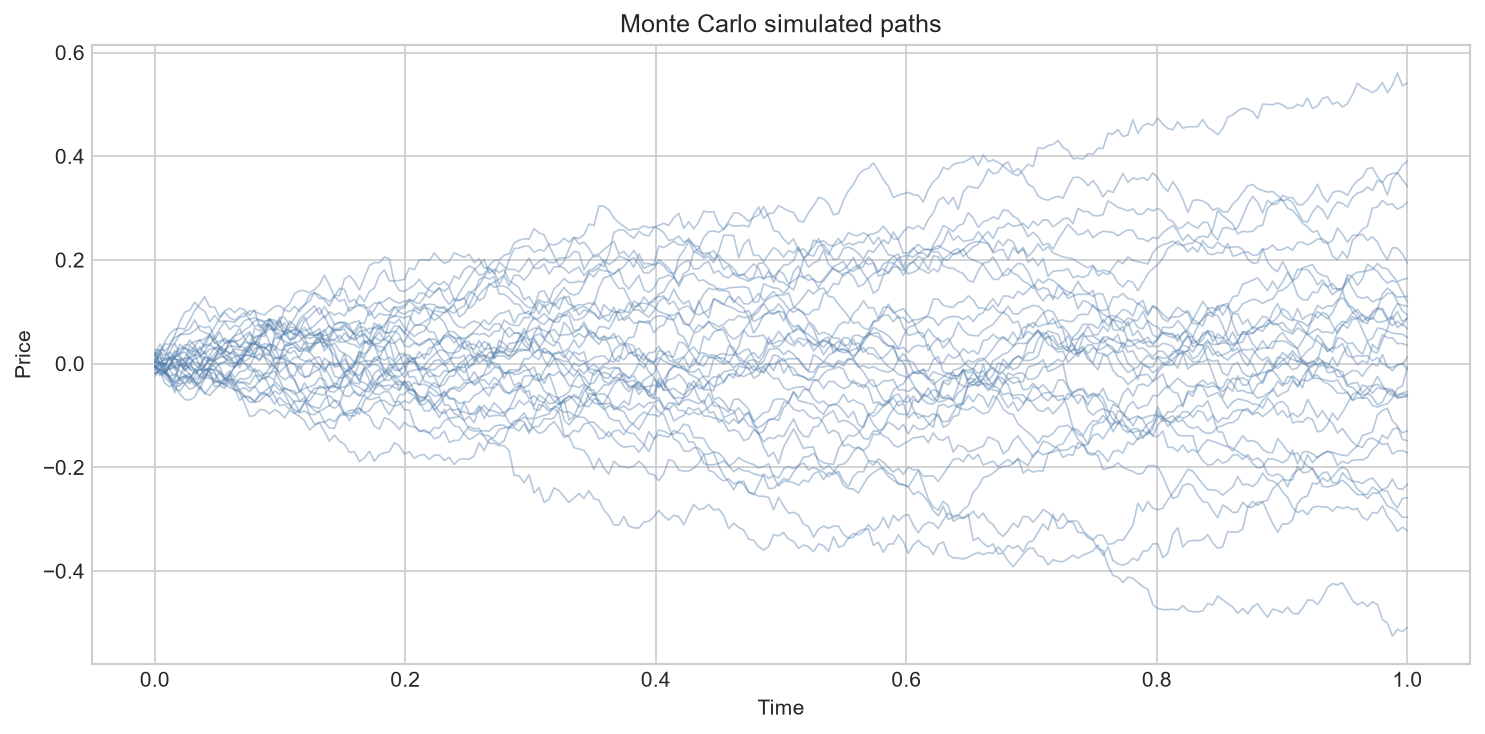
A Monte Carlo run conjures many possible futures from a single starting point:
 Monte Carlo simulated paths
Variance reduction matters. Antithetic variates pair positive and negative shocks. Control variates borrow a related problem whose solution is known. Importance sampling concentrates the draws where they count, above all in the tails. Quasi-Monte Carlo replaces random draws with low-discrepancy sequences. The right technique can shrink the required sample size by orders of magnitude.
Path dependence is where Monte Carlo shines. An Asian option payoff hangs on the average price over a path; a barrier option on whether the price touched a level; a strategy P&L on the sequence of returns and the rebalancing decisions. Closed-form solutions for such things are rare birds.
Bootstrapping is a close cousin. In place of a parametric model, one resamples historical returns. Block bootstrap preserves time dependence; stationary bootstrap samples blocks of random length. The gain is that no normal distribution is assumed; the cost is the assumption that the future resembles the past.
Scenario analysis is simulation done deliberately. One specifies stressed paths, a credit freeze, a sovereign default, a geopolitical shock, and watches what follows. This is less a question of probability than of preparedness. See Stress Testing and Scenario Design for the design side.
The danger of Monte Carlo is false precision. A simulation of a million paths is no better if the model is wrong. Fat tails, regime changes, and liquidity crises are hard to encode in a clean stochastic process; the output will be only as good as the assumptions.
Monte Carlo serves best to illumine distributions, not to fix point estimates. It tells what can happen, how often, and with what severity, and that knowledge feeds position sizing, risk limits, and strategic decisions. It complements the analytical model; it does not replace it.