Stress Testing and Scenario Design [/ˈstrɛs ˈtɛstɪŋ ənd sɪˈnɛrioʊ dɪˈzaɪn/] n - Stress testing is the answer to a particular failure: statistical risk models serve until they do not. Correlations collapse toward one in crises, and volatility estimates drawn from calm periods run too low. A stress test asks what happens when the world behaves badly, not what happens on average.
Scenario design is the hard part. Historical scenarios use real events: the 2008 financial crisis, the 2020 pandemic shock, the 1987 crash, the 2011 European debt crisis. They have the virtue of being real, and the defect that the next crisis may not resemble the last.
Hypothetical scenarios oblige you to imagine what has not happened: a sovereign default by a major issuer, a cyber attack upon clearing infrastructure, a sudden reversal of global capital flows. These try the imagination and the institutional memory as much as the mathematics.
Reverse stress testing turns the question about. Begin with the loss that would render the firm insolvent, and ask what scenario would bring it forth. The answer is oft more useful than a standard stress test, for it names the vulnerabilities that matter most.
Aggregation is treacherous. A portfolio may pass each asset-class stress in turn and fail when the stresses arrive together. Cross-asset correlations spike in crises; funding liquidity evaporates just as market liquidity does. A good stress test weighs the interactions, not merely the isolated shocks.
The correlation matrix in calm times and in crisis can look like two different creatures:
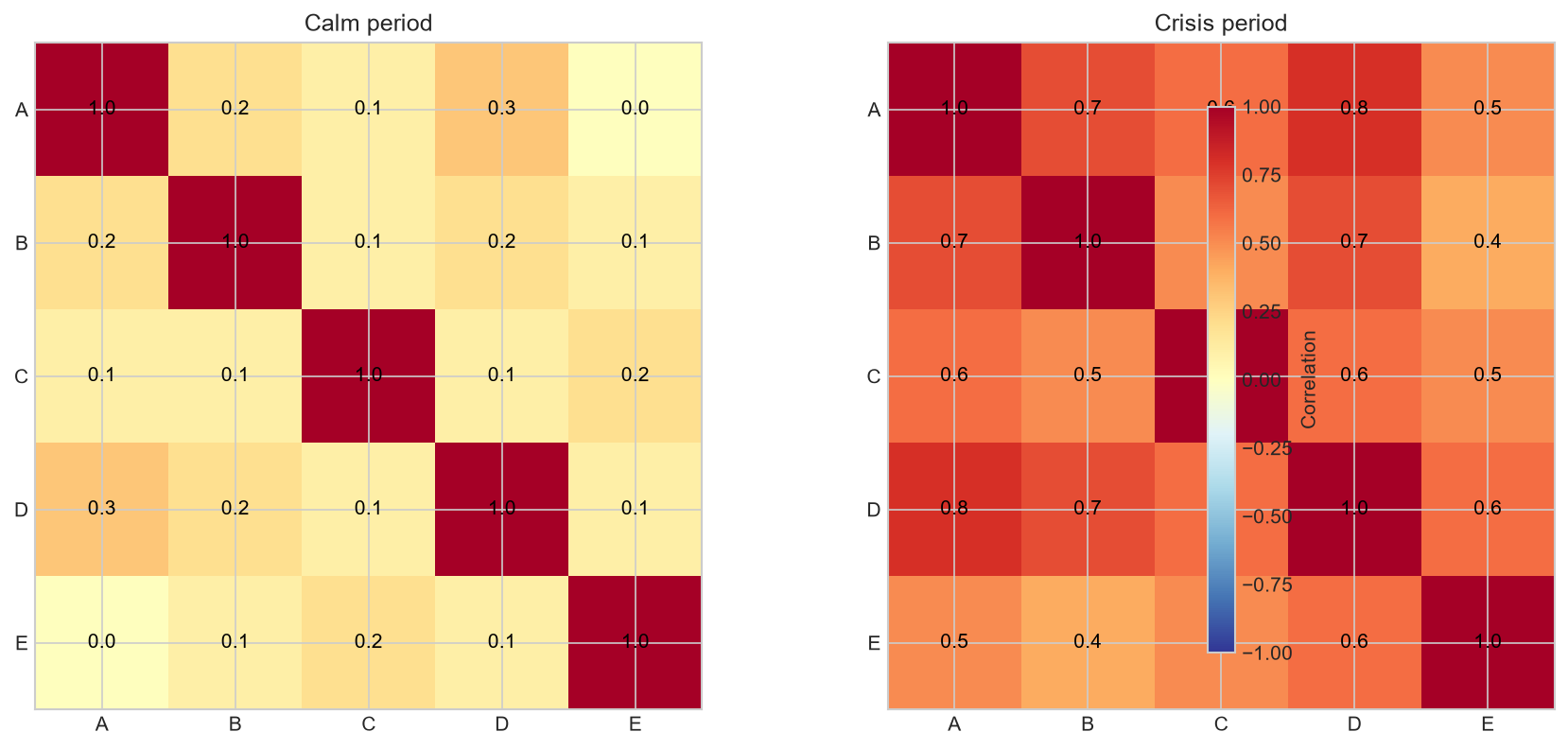 Calm versus crisis correlation matrices
Diversification works in the left panel; it vanishes in the right.
Scenarios ought to be translated into action. Which positions would you reduce? Which hedges would you set on? How swiftly can you execute? A stress test that yields only a report is a compliance exercise; one that yields a playbook is risk management.
Frequency matters. Markets evolve, and scenarios must evolve with them. A scenario built upon the European debt crisis is less pertinent today, and new risks arise: climate transition, artificial intelligence disruption, changes in monetary policy regimes. The scenario library should be reviewed and renewed at regular intervals.
Stress testing complements Value at Risk and Expected Shortfall; it does not replace them. VaR measures risk in ordinary conditions, stress testing in extraordinary ones, and a firm needs both. A trader who trusts VaR alone is unready for the days that define a career.