The Greeks in Practice [/ðə ˈgriks ɪn ˈpræktɪs/] n - The Greeks measure how an option price or portfolio value shifts when market inputs move. They are first and second derivatives, and they form the chief language of risk management on derivatives desks.
The Greeks trace how an option’s price and exposures move with the underlying. A call’s price rises smoothly toward intrinsic value, while delta rises from zero to one:
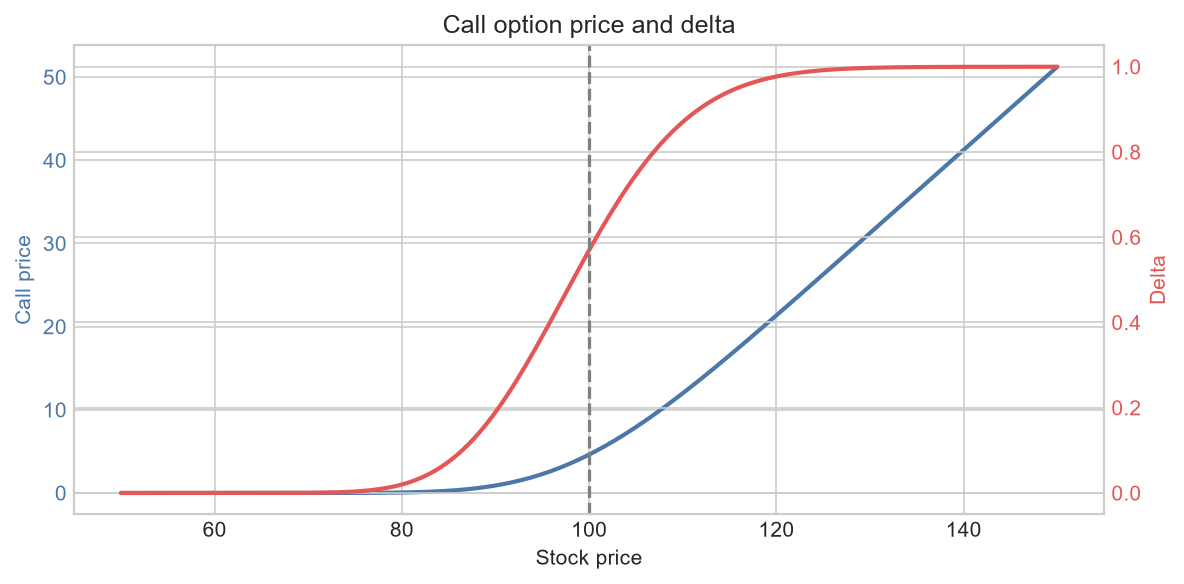 Call option price and delta
Delta is the first derivative with respect to the underlying price:
It is the equity-equivalent exposure. A call bears positive delta, a put negative. A delta-hedged position is locally neutral to small moves in the underlying, yet it is not risk-free.
Gamma is the second derivative with respect to price:
Gamma tells how fast delta changes. High gamma means the hedge wants frequent rebalancing; for a delta-hedged book, gamma decides whether the position profits from large moves or loses by them. Long options carry positive gamma, short options negative.
Vega is sensitivity to implied volatility:
Vega is usually greatest for at-the-money options and grows with time to expiration. A book short vega loses money when implied volatility rises, even if the underlying does not stir.
Theta is the daily time decay:
Long option positions usually bear negative theta, short positions positive. The theta gathered by selling options is recompense for the gamma risk.
Higher-order Greeks matter in large or complex books. Vanna is the derivative of delta with respect to volatility, volga the derivative of vega with respect to volatility. They describe how hedging ratios shift across the volatility surface, and they grow important when the book holds options across strikes and maturities.
The Greeks are local approximations, sound for small moves and short horizons. Large moves, jumps, and shifts in the whole volatility surface demand scenario analysis and stress tests; see Stress Testing and Scenario Design for how to pass beyond first-order sensitivities.