Kelly Criterion and Optimal Bet Sizing [/ˈkɛli kraɪˈtɪriən ənd ˈɑptɪməl ˈbɛt ˈsaɪzɪŋ/] v - The Kelly criterion gives the wager that maximizes the expected growth rate of wealth. For a simple bet with probability of winning at odds , the fraction of capital to stake is:
The Kelly fraction balances growth against ruin. The curve crests at full Kelly; most traders, knowing their own fallibility, operate to the left of the crest:
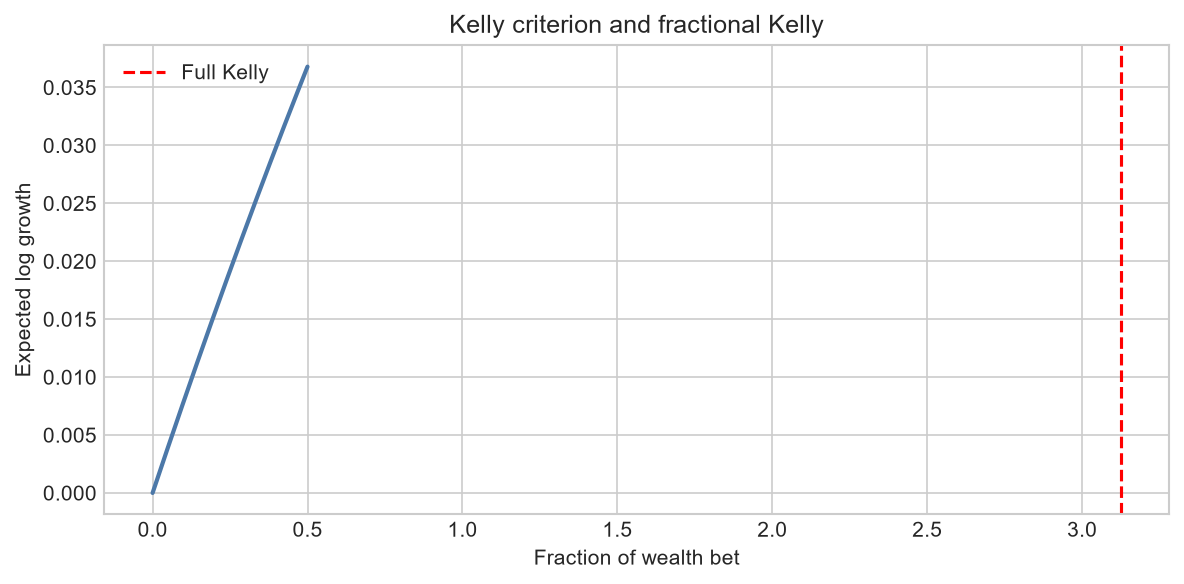 Kelly criterion and fractional Kelly
For a continuous strategy of mean and variance , the allocation is approximately:
This is the same form that appears in mean-variance optimization when one maximizes the log of wealth; the Kelly fraction is the leverage that maximizes the expected log-return.
Full Kelly is almost always too aggressive in practice. It assumes the parameters known exactly, the returns log-normal, the book unconstrained. In truth and are estimated with error, and an overestimated yields leverage enough for large drawdowns. The common compromise is fractional Kelly: half the fraction, or a quarter, trading some growth for quieter volatility.
Drawdowns are the reason traders shun full Kelly. The growth-optimal strategy can suffer peak-to-trough losses past psychological and institutional limits; what is mathematically optimal may be operationally unusable.
In a portfolio the sizing extends to many correlated bets. The vector of optimal positions is proportional to the inverse covariance matrix times the vector of expected returns. Again it resembles mean-variance optimization, and it inherits the same estimation ills. See Modern Portfolio Optimization for the kindred problems.
The framework imposes a useful discipline: it parts the forecast from the sizing. A strong signal with low volatility earns a large position; a weak signal or high uncertainty, a small one. Size should record the quality of the edge, not the confidence of the forecaster.