Bayesian Updating for Beliefs [/ˈbayesian ˈəpˌdeɪtɪŋ fər bɪˈlifs/] n - Bayesian methods oblige you to be honest about what you already believe. A prior distribution records your assumptions before the data is seen; a likelihood function tells how the data might have arisen; the posterior joins the two. In trading, the posterior is the distribution on which you should truly trade.
Bayes’ theorem in its continuous form is:
Or in the shorthand every quant keeps: posterior is proportional to likelihood times prior.
The formula is simple. The practice is not, for priors are hard. A prior too strong swamps the data; one too weak lets the noise rule. The art lies in choosing a prior that carries real economic knowledge without rendering the analysis circular. It helps to watch the prior narrow as evidence arrives:
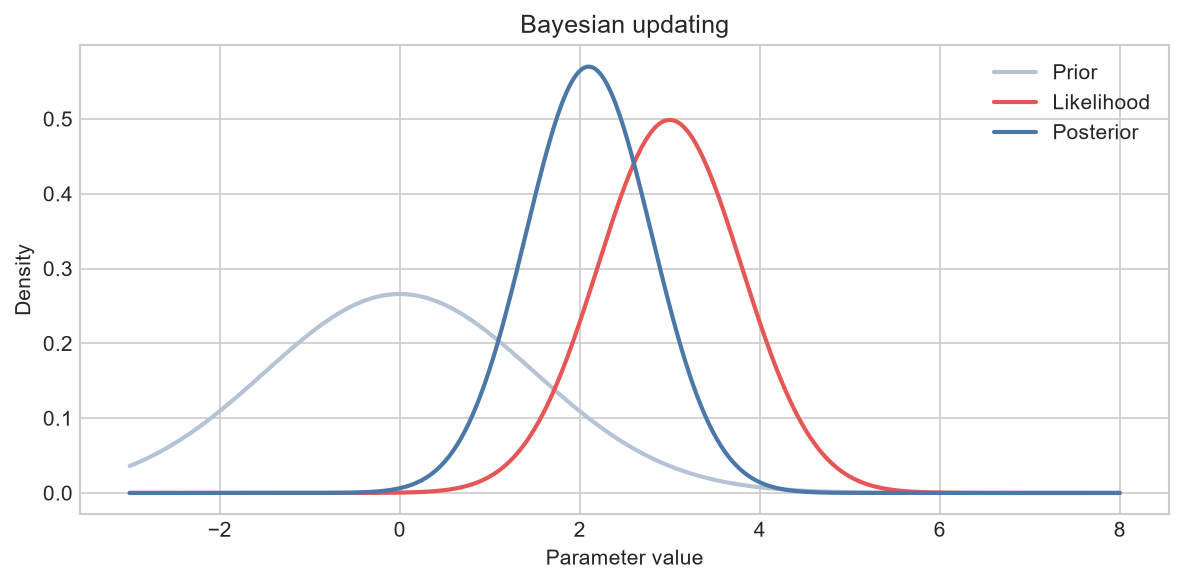 Bayesian prior, likelihood, and posterior
Where These Methods Shine
Bayesian methods earn their keep where data is scarce. A new strategy, a thin market, the probability of a rare event: in each, frequentist point estimates are unsteady, and a Bayesian interval that owns its prior uncertainty serves better than a t-statistic built on fifty observations.
In portfolio construction, Bayesian shrinkage is a standard instrument. The Black-Litterman model begins with an equilibrium prior (the market portfolio) and updates it with investor views; the result is a portfolio that does not fly to extreme weights on faint evidence. It is a disciplined way to mingle theory and opinion.
Model comparison is another strength. Bayes factors weigh the marginal likelihood of rival models, penalizing complexity of their own accord. Cross-validation does much the same in the frequentist world, yet Bayes factors sit more naturally when models are nested or when priors bear real information.
Computation was once the bottleneck. Markov Chain Monte Carlo made many Bayesian models feasible; today variational inference and sequential Monte Carlo hasten matters further. The constraint is no longer the sampler. It is the specification of the prior and the model.
A Word of Caution
Bayesian methods can be made to launder assumptions. A cunningly chosen prior can render nearly any conclusion reasonable. The defense is transparency: state the prior, show how the posterior shifts when the prior shifts, and report the sensitivity. If the conclusion hangs wholly upon the prior, you do not hold evidence. You hold a belief.